
Common HOA Disputes Solved Peacefully | HOA Plus
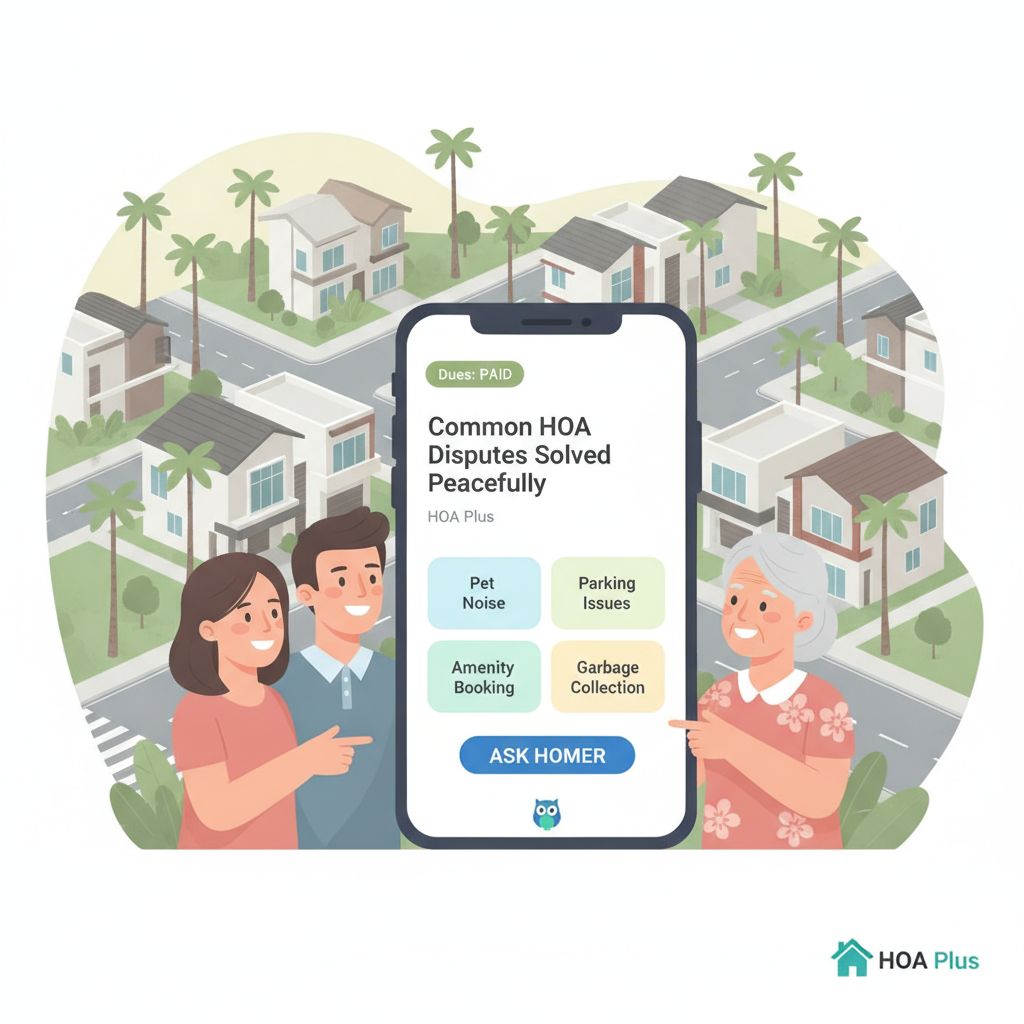
Common HOA Disputes in the Philippines and How to Resolve Them Peacefully
Common HOA disputes are an everyday reality in Philippine subdivisions — from disagreements over parking spaces to arguments about noise levels that spill into the neighborhood Viber group chat. These conflicts can turn friendly neighbors into bitter opponents, but they do not have to. Most common HOA disputes follow predictable patterns, and with the right approach, your community can resolve them before they escalate into something worse.
Every homeowner has experienced or witnessed a dispute in their subdivision. Maybe it was about someone parking in front of your gate. Maybe it was about a neighbor’s dog barking at midnight. Or maybe it was about where exactly your association dues are going each month. Whatever the trigger, common HOA disputes share one thing: they thrive on poor communication and a lack of clear processes for resolution.
Why Common HOA Disputes Happen in Philippine Subdivisions
Understanding why common HOA disputes arise is the first step toward solving them. In most Philippine subdivisions, the root causes are surprisingly consistent. Homeowners rarely see the full picture of how their community is managed. Board members often volunteer their time and lack formal training in conflict resolution. Furthermore, rules exist somewhere in a printed document that nobody has read since moving in five years ago.
The informal nature of many HOAs creates additional confusion. When a neighbor parks in your spot, who do you tell? The president? The barangay? The Viber group chat? Without a clear process, frustrated residents vent in the wrong places, making small problems feel much bigger than they actually are. Therefore, common HOA disputes escalate not because the original issue was serious, but because no one knew how to handle it properly from the start.
The Most Common HOA Disputes Every Community Faces
Not all common HOA disputes are the same, but most fall into a handful of categories that repeat across subdivisions everywhere. Recognizing these patterns helps your board prepare solutions before tensions boil over.
1. Parking and Vehicle-Related Conflicts
Parking disputes are probably the most common HOA disputes in any Philippine subdivision. Cars blocking driveways, motorcycles taking up visitor slots, and guests parking wherever they please create daily friction. Consequently, what starts as a minor inconvenience can quickly become a heated argument between neighbors who see each other every single day.
The solution is straightforward: your HOA needs clear, written parking rules that every resident receives when they move in. Similarly, there should be a simple process for reporting violations — one that does not require confronting your neighbor face-to-face if you would rather not.
2. Noise Complaints and Disturbances
Noise is another constant source of common HOA disputes. Filipino gatherings are naturally lively, but when a neighbor’s karaoke machine runs past midnight on a weeknight, patience wears thin. Similarly, loud pets, construction noise, and late-night parties can make subdivision living feel like a constant battle for peace and quiet.
Therefore, the best approach is proactive: establish quiet hours in your community guidelines, communicate them clearly, and enforce them consistently. Meanwhile, give residents a way to file noise complaints that does not force them to knock on a stranger’s door in the dark.
3. Delinquent HOA Dues and Financial Transparency
Money matters are some of the most sensitive common HOA disputes. When homeowners do not pay their dues, the community suffers — but aggressive collection tactics can damage relationships. Similarly, when residents do not see where their money goes, suspicion grows and trust erodes quickly.
The fix is radical transparency. Every peso collected should be accounted for in a report that any member can access. In addition, boards should communicate clearly about what happens when dues go unpaid, following a consistent process that treats every homeowner the same way.
4. Property Modifications and Aesthetic Rules
Disputes over home improvements are surprisingly common HOA disputes. A homeowner paints their gate a bright color, builds an extension without approval, or plants tall hedges that block a neighbor’s view. The board steps in, the homeowner feels targeted, and suddenly everyone is upset about something that could have been prevented with a simple conversation.
Ultimately, the issue is communication. Homeowners often do not know they need approval before making changes. Boards, for their part, sometimes enforce rules inconsistently — coming down hard on one resident while ignoring the same violation from another. Therefore, clarity and consistent enforcement are essential.
How to Resolve Common HOA Disputes Without Making Things Worse
The good news is that most common HOA disputes can be resolved peacefully, often without any formal process at all. However, this only works when the board has put the right systems in place ahead of time.
First, establish a clear complaint process. Every resident should know exactly how to report a concern — and it should not involve posting in the community group chat. A private reporting channel protects everyone’s dignity and keeps small issues from becoming neighborhood-wide drama.
Second, communicate rules proactively. When every homeowner receives a copy of the community guidelines upon move-in — and when those rules are accessible anytime through a digital platform — there is far less room for the “I didn’t know” defense. HOA Plus makes this easy by keeping all community documents in one searchable place.
Third, enforce rules consistently. Nothing fuels common HOA disputes faster than the perception that some residents get special treatment. When the board applies the same standards to everyone — including board members themselves — the community trusts the process and accepts outcomes more readily.
Fourth, offer mediation before escalation. For serious disputes that cannot be resolved informally, a neutral third party can help both sides find common ground. In the Philippines, barangay conciliation is a legally recognized first step for many disputes, and your HOA board should understand when and how to use it.
How HOA Plus Helps Prevent Common HOA Disputes Before They Start
Many common HOA disputes never need to happen at all. When your community has the right infrastructure — transparent finances, accessible rules, clear reporting channels, and consistent enforcement — conflicts drop dramatically. HOA Plus was built specifically for this purpose: to give Philippine subdivisions the tools they need to run smoothly and peacefully.
With HOA Plus, every resident can access community bylaws instantly just by asking HOMER, the platform’s digital concierge. There is no need to dig through dusty binders or scroll endlessly through old announcements. Similarly, financial reports are available at any time, so no homeowner ever has to wonder where their dues are going.
The platform also includes tools for anonymous reporting and facility booking, removing two of the biggest friction points that lead to common HOA disputes. When neighbors can report concerns privately and book shared spaces through a fair, transparent system, the daily frustrations that build into major conflicts simply disappear.
For board members, HOA Plus provides a centralized dashboard where all complaints, payments, and communications are tracked in one place. This creates an automatic audit trail, protects the board from accusations of favoritism or neglect, and makes it easy to follow up on every concern until it is resolved.
Building a Community Where Disputes Are Rare
The ultimate goal is not just to handle common HOA disputes when they arise — it is to build a community where they rarely happen in the first place. This requires a shift in mindset from reactive enforcement to proactive community building.
Neighbors who know each other are less likely to escalate minor issues into major conflicts. Communities that communicate clearly have fewer misunderstandings. And boards that lead with transparency earn the trust that makes residents more willing to follow the rules without being forced.
For example, regular community events — even simple ones like a weekend cleanup drive or a holiday gathering — help neighbors see each other as people rather than just the source of the next complaint. Ultimately, common HOA disputes are not really about parking spots or noise levels. They are about relationships, respect, and feeling heard.
Start building a more peaceful subdivision today. Try HOA Plus free and see how the right tools can reduce conflicts, increase transparency, and make your community a better place to call home.
Learn more at hoa-plus.app.
Related Reading:
- RA 9904 Explained: The Philippine HOA Law Every Homeowner Should Understand
- How to Handle a Noisy Neighbor in Your Subdivision Without Starting a War
For more information on alternative dispute resolution in the Philippines, visit the Department of the Interior and Local Government (DILG) website.
