
What Is an HOA Philippines? | HOA Plus
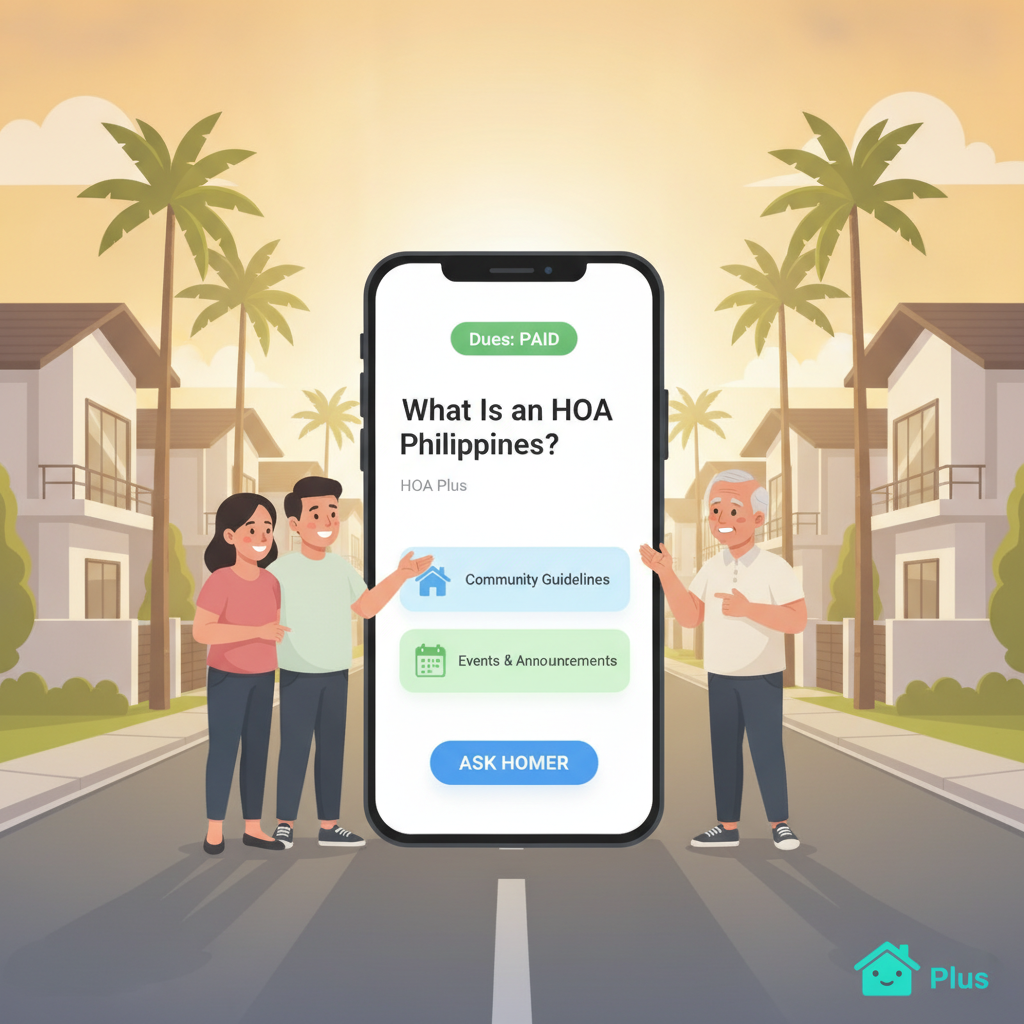
What Is an HOA Philippines? A Complete Guide for Filipino Homeowners
If you live in a subdivision in the Philippines, you have probably heard the term HOA Philippines thrown around in group chats or during neighborhood meetings. But what exactly is a homeowners association, and why does it matter to your everyday life? Simply put, an HOA Philippines is the backbone of organized subdivision living — it is the group responsible for maintaining your community’s security, cleanliness, and harmony.
Whether you are a new homeowner trying to understand your monthly dues or a long-time resident wondering why your subdivision needs an association, this guide covers everything you need to know about how an HOA Philippines works and why it benefits everyone in the community.
What Is a Homeowners Association in the Philippines?
A homeowners association, commonly called an HOA Philippines, is an organization formed by subdivision residents to manage and maintain their shared community. Every homeowner who buys property inside the subdivision automatically becomes a member. The association is run by a board of directors elected by the members, and it operates under Philippine law — specifically Republic Act 9904, also known as the Magna Carta for Homeowners and Homeowners Associations.
In practice, your HOA Philippines handles everything from gate security and street lighting to garbage collection and landscaping. It is the reason your subdivision looks clean, your guardhouse is staffed, and your clubhouse stays functional. Without an active HOA, these shared responsibilities fall apart quickly.
Furthermore, an HOA Philippines is not a government body. It is a private, non-profit organization funded entirely by the monthly dues collected from homeowners. Consequently, every peso you pay goes back into maintaining and improving the community you live in.
Why Every Subdivision in the Philippines Needs an HOA
Imagine moving into a beautiful subdivision with wide roads, a swimming pool, and 24-hour security. Now imagine all of that slowly disappearing because nobody is in charge of maintaining it. That is what happens when a subdivision lacks a functioning HOA Philippines.
Your homeowners association is the single group that keeps your property value from dropping. Clean streets, working streetlights, guarded gates, and well-kept common areas do not happen by accident. They require funding, planning, and consistent effort — and that is exactly what an HOA Philippines provides.
Similarly, an HOA serves as the official voice of the community. When your subdivision needs to coordinate with the barangay, request road repairs from the city, or negotiate with utility providers, the HOA Philippines represents every homeowner. One organized voice carries far more weight than dozens of individual complaints.
Therefore, a well-run HOA is not just about collecting dues. It is about protecting your investment, preserving your quality of life, and making sure your neighborhood remains a place you are proud to call home.
The Legal Foundation of an HOA Philippines
Every HOA Philippines operates under Republic Act 9904, which the Philippine government passed to protect homeowners and standardize how associations work across the country. This law defines your rights as a homeowner, sets rules for fair elections, and requires financial transparency from your board.
For example, RA 9904 states that your HOA must hold regular general assemblies, present financial reports to members, and allow homeowners to inspect association records. In addition, it protects you from unreasonable fines and gives you the right to vote on major community decisions. You can read the full text on the Official Gazette website.
However, having a law on the books is only half the battle. Your HOA Philippines needs an active, informed board and engaged homeowners to turn those legal protections into real community benefits. A board that understands RA 9904 can run fair elections, manage funds responsibly, and handle disputes professionally — all of which keeps your neighborhood peaceful and well-maintained.
What Does Your HOA Actually Do Every Day?
Most homeowners only think about their HOA Philippines when their dues are due or when something goes wrong. Nevertheless, your association works quietly behind the scenes every single day to keep your subdivision running smoothly.
Here are the core responsibilities of a typical HOA Philippines:
- Security management: Hiring guards, maintaining gates, and enforcing visitor policies
- Common area upkeep: Landscaping, street lighting, park maintenance, and clubhouse cleaning
- Garbage collection: Coordinating with waste management services and keeping streets clean
- Financial administration: Collecting dues, paying bills, and producing transparent financial reports
- Rule enforcement: Making sure everyone follows subdivision policies on parking, noise, pets, and renovations
- Community events: Organizing holiday celebrations, general assemblies, and neighborhood activities
Consequently, when these responsibilities are handled well, you barely notice the HOA at all — and that is exactly the point. A great HOA Philippines works so seamlessly that you simply enjoy living in a clean, safe, and well-managed community.
Your Rights as a Member of an HOA Philippines
Being a member of an HOA Philippines is not a one-way relationship where you just pay dues and follow rules. You have real rights that protect you and give you a voice in how your community is run.
First, you have the right to vote in board elections and on major community decisions. Your HOA Philippines cannot raise dues, approve large expenses, or change the bylaws without member approval. Specifically, RA 9904 requires a majority vote from members for any significant financial or policy change.
Additionally, you have the right to run for a board position yourself. If you want to take a more active role in shaping your community, you can campaign for a seat and serve your neighbors. For a detailed look at what board service involves, check out our guide on HOA board member duties in the Philippines.
Meanwhile, you also have the right to access financial records, meeting minutes, and official documents. Transparency is not optional — it is the law. Your HOA Philippines must show you exactly where your dues are going and how decisions are being made.
How Technology is Changing the HOA Philippines Experience
Traditionally, running an HOA Philippines meant stacks of paper records, endless Viber group chats, and face-to-face meetings that dragged on for hours. Meanwhile, homeowners struggled to get simple answers about their dues, upcoming events, or community rules.
Today, digital tools are transforming how associations operate. Modern HOA Philippines management platforms let board members track dues payments, manage facility bookings, share announcements, and handle complaints — all from a single dashboard. Homeowners can check their account balance, report issues, and vote on community matters right from their phone.
For example, instead of digging through fifty pages of printed bylaws to find a rule about parking, residents can simply ask a digital assistant that has read every community document. Specifically, HOA Plus includes HOMER — a smart concierge that answers your questions instantly. This means fewer arguments, faster resolutions, and a lot less stress for everyone involved.
Furthermore, digital HOA Philippines management brings much-needed transparency to association finances. When every payment, expense, and budget item is tracked in a system that homeowners can access, the old question of “Where do our dues go?” disappears entirely.
What Happens When a Subdivision Has No HOA?
To understand the value of an HOA Philippines, consider what life looks like without one. When no association exists, or when the existing one stops functioning, the effects are immediate and visible.
Security becomes inconsistent because nobody is paying the guards or maintaining the gate. Streetlights burn out and stay dark for months. Garbage piles up because collection services were cancelled due to unpaid bills. Common areas like parks and clubhouses fall into disrepair. Ultimately, property values drop because the neighborhood looks neglected and unsafe.
In addition, disputes between neighbors have no formal process for resolution. When a neighbor plays loud music at midnight or parks their car blocking your driveway, there is no organized body to mediate. Consequently, small conflicts escalate into lasting feuds that make daily life stressful for everyone.
Therefore, whether you are buying a home or already living in one, an active and well-managed HOA Philippines is not a luxury — it is a necessity for preserving both your peace of mind and your property’s long-term value. If your subdivision does not yet have an HOA, read our step-by-step guide on how to start an HOA in the Philippines.
How to Make the Most of Your HOA Philippines Membership
Being a passive member who only grumbles about dues and rules does not help anyone — including you. Similarly, a community where nobody participates is a community that slowly declines. Here are simple ways to get more value from your HOA Philippines membership:
- Attend general assemblies: Show up, ask questions, and vote. These meetings are where decisions get made, and your voice matters.
- Read the financial reports: Know where your money goes. Transparency builds trust, and an informed membership keeps the board accountable.
- Report issues promptly: If a streetlight is out or a gate is broken, tell the board right away. Small problems get fixed faster when they are reported early.
- Consider board service: If you have ideas for improving the community, run for a position. Good boards need good people.
- Use available tools: If your HOA Philippines offers a management app or online portal, use it. These tools make staying informed and getting help dramatically easier.
Ultimately, a homeowners association is only as strong as its members. When homeowners engage, participate, and hold their board accountable, the entire community benefits.
Start Building a Better Community Today
Your HOA Philippines is more than a dues-collecting organization — it is the foundation of your daily quality of life at home. From security and cleanliness to dispute resolution and community events, a well-run association makes subdivision living better for everyone.
If your community is ready for a modern approach to HOA management, HOA Plus gives your board and homeowners the tools they need to stay organized, transparent, and connected. Track dues, manage facilities, share announcements, and resolve issues — all in one place. See how HOA Plus works for your community.