
Where Do My HOA Dues Go? A Filipino Homeowner’s Guide to Dues Transparency
You pay your HOA dues every month — on time, without complaint — but you have no idea where the money actually goes. You ask the treasurer in the group chat, and the reply is either a vague “it’s in the financial report” or a defensive “attend the GA if you want to know.” Sound familiar? You’re not the only one asking this question, and HOA dues transparency in the Philippines shouldn’t be this hard to get.
The HOA Dues Transparency Problem in Philippine Subdivisions
In most Philippine subdivisions, the flow of money is one of the biggest sources of frustration and distrust. Homeowners hand over their monthly dues and expect the community to be maintained — the guards paid, the streetlights working, the clubhouse in good shape. But when there’s no clear breakdown of where every peso goes, doubt creeps in fast.
It usually starts with small things. The gate arm has been broken for weeks. The landscaping looks neglected. A new project gets announced but nobody remembers approving it. And then the question surfaces — in the Viber GC, at the general assembly, or in a private conversation between frustrated neighbors: “Where do our HOA dues go?”
The problem isn’t always that the Board is doing something wrong. More often, it’s that the Board is doing things right but has no efficient way to show it. Financial records are trapped in spreadsheets that only the treasurer understands. Receipts are stuffed in folders. Reports are presented once a year at a GA that half the residents don’t attend. The result? Even well-managed HOAs end up looking suspicious because there’s no visible trail between your payment and the community’s expenses.
What Philippine Law Says About HOA Dues Transparency
Before we talk about solutions, it helps to know your rights. Under Republic Act 9904 — the Magna Carta for Homeowners and Homeowners’ Associations — every member of an HOA has the right to inspect and examine the financial statements, minutes of meetings, and other records of the association. This isn’t a favor from the Board. It’s the law.
HOA officers are also required to act with transparency, accountability, and fairness. That means the Board isn’t just encouraged to share financial information — they’re legally obligated to make it accessible to any homeowner who asks. If your HOA hasn’t been sharing regular financial reports, that’s not just poor management. It’s a governance issue that the Department of Human Settlements and Urban Development (DHSUD) can step in to address.
The challenge, of course, is that most HOA boards aren’t trying to hide anything. They simply don’t have the tools to present financial information in a way that’s easy for hundreds of homeowners to access and understand. That’s where the old system — paper reports, annual GAs, and spreadsheet printouts — falls short.
Where Your HOA Dues Typically Go
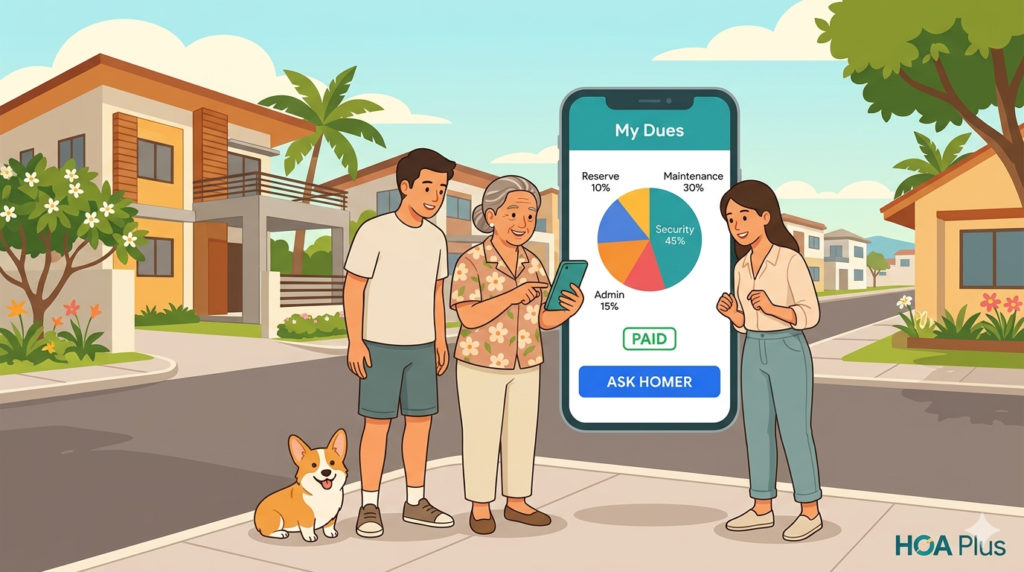
If you’ve ever wondered what your monthly dues actually pay for, here’s a general breakdown that applies to most Philippine subdivisions:
Security and Personnel
This is usually the biggest chunk — anywhere from 40% to 60% of your total dues. It covers the salaries and benefits of security guards, roving patrols, gate personnel, and sometimes maintenance staff. If your subdivision operates 24/7 security with multiple shifts, this cost adds up quickly.
Utilities and Common Area Maintenance
Streetlights, water for common areas, clubhouse electricity, elevator maintenance for high-rise communities, landscaping, pest control, and garbage collection. These are the day-to-day costs of keeping the subdivision functional and presentable.
Repairs and Capital Improvements
Road resurfacing, drainage repairs, perimeter wall maintenance, CCTV upgrades, playground equipment — anything that improves or maintains the physical infrastructure of your community. Some HOAs set aside a portion of dues into a reserve fund specifically for these bigger expenses.
Administrative and Operational Costs
Office supplies, accounting services, insurance, legal fees, software subscriptions, and other costs of running the HOA as an organization. This also includes expenses for general assemblies, elections, and community events.
The issue isn’t that these expenses are unreasonable. The issue is that most homeowners never see a clear, itemized version of this breakdown. And when you’re paying thousands of pesos every month without a receipt-level view of where it goes, frustration is natural.
How HOA Plus Makes HOA Dues Transparency Effortless
This is exactly the problem that HOA Plus was built to solve — not just collecting dues, but making every peso trackable from the moment it leaves your pocket to the moment it’s spent on your community.
Your Personal Ledger — See Every Transaction
Every homeowner gets their own personal ledger inside the app. It shows exactly what you owe (“To Pay”) and a complete history of every payment you’ve made. No more chasing the treasurer to ask if your payment was recorded. No more wondering whether that advance payment you made three months ago was properly credited. It’s all there — organized, timestamped, and accessible anytime.
Transparent Community Billables
On the admin side, the Board can create billing templates for different types of charges — monthly dues, quarterly assessments, special contributions, one-time fees. Each billable is clearly labeled so residents know exactly what they’re being charged for. Late fees? They’re calculated automatically based on rules the Board sets, including grace periods. No more manual computations, no more disputes about who was charged what.
If you want to dive deeper into how community billables work, check out our earlier post on transparent community billables — it covers the full system in detail.
Collection Health Dashboard
The Board gets a visual dashboard showing collection rates, outstanding balances, and financial health — complete with charts. This isn’t a spreadsheet that only the treasurer can interpret. It’s a clear, visual summary that any Board member can pull up during a meeting and share on screen. When residents ask “how are we doing on collections?” the answer is right there.
Project Tracking with Budget Transparency
When the HOA spends dues on a project — say, repainting the perimeter wall or installing new CCTV cameras — HOA Plus lets the Board track it with full budget details, milestones, and an expense ledger. Residents can see the project’s progress, how much was budgeted, how much has been spent, and what’s left. This is the kind of transparency that turns skeptics into supporters.
Digital Payment Proof
Homeowners can submit their payment proof directly through the app — just snap a photo of your receipt or bank transfer confirmation and upload it. The Board reviews and approves it, and your ledger updates instantly. No more passing receipts through the guard, no more “I already paid but it’s not reflected” arguments.
How HOA Dues Transparency Benefits Every Homeowner
When you can see exactly where your money goes, something shifts. The suspicion fades. The group chat arguments about finances die down. You stop wondering whether the Board is mismanaging funds because the evidence is right in front of you — every billing statement, every project expense, every collection report.
For working parents who can’t attend every GA, HOA dues transparency through an app means you’re never out of the loop. For seniors who aren’t comfortable navigating spreadsheets, a simple ledger view on their phone is all they need. For new homeowners who just moved in and don’t know how the HOA operates, having financial information available from day one builds immediate trust.
And when trust goes up, participation goes up. People pay their dues on time because they can see the value. They support new projects because they can track the spending. They stop posting angry messages in the group chat because the answers are already available. That’s what a well-managed community hub looks like.
How HOA Dues Transparency Reduces Your Board’s Workload
If you’re a Board member or treasurer reading this, you already know the pain. Every month, it’s the same cycle — generate bills, chase payments, answer the same questions about balances, defend your spending decisions in the group chat, and then spend hours preparing a financial report that most residents won’t read anyway.
HOA Plus takes most of that off your plate. Billing templates mean you set it up once and the system generates bills automatically — monthly, quarterly, or however your HOA structures it. Late fees apply on their own based on the rules you define. Payment approvals are streamlined with digital proof submissions. And the collection dashboard gives you a real-time view of who’s paid and who hasn’t, so you can follow up efficiently instead of guessing.
But the biggest win is this: when everything is transparent and accessible to residents, the questions stop. The accusations stop. The defensive GC messages stop. You spend less time explaining yourself and more time actually managing the community. That’s not just efficiency — that’s peace of mind for your entire Board.
Stop Guessing — Start Seeing Where Your Dues Go
Every homeowner deserves to know exactly where their money goes. Every Board deserves a system that makes financial transparency effortless instead of exhausting. HOA dues transparency isn’t a luxury — it’s the foundation of a healthy, trusting community.
Try HOA Plus free for your community. Visit hoa-plus.app and see how transparent billing, automated collections, and real-time financial tracking can transform the way your subdivision handles dues.
Want to learn how your HOA can resolve disputes without the drama? Read our guide on safe anonymous neighbor reports — another way HOA Plus builds trust in your community.