
HOA Member Directory App Philippines
Knowing Your Neighbors Without the Awkwardness: The HOA Member Directory App Philippines Subdivisions Actually Need
You have lived in your subdivision for three years. You smile at the man in Block 7 every morning. You wave at the woman walking her Shih Tzu every evening. You have no idea what their names are. You certainly do not have their phone numbers. When a package gets delivered to the wrong house, you post in the Viber group chat and hope someone recognizes the name on the label.
This is subdivision life in the Philippines. We live close to each other. We share gates, guards, and garbage collection schedules. We talk about barking dogs and parking spots in group chats filled with hundreds of messages. But when something actually matters — when a tree branch is about to fall on your roof and you need to warn the neighbor whose number you never saved — you realize how disconnected you really are.
A proper HOA member directory app Philippines communities are now adopting changes everything about how neighbors connect. It brings organization to what has always been chaos. Furthermore, it gives every homeowner something they did not know they were missing: a real sense of who their community actually is.
The Problem: Familiar Faces, Complete Strangers
Most subdivisions operate on a strange contradiction. Residents share walls, hallways, and amenities with dozens of families. However, they have no reliable way to reach each other. The tools they rely on are not designed for community connection.
Group chats on Viber and Messenger become dumping grounds for everything — announcements, complaints, lost pets, party invitations, and forwarded chain messages. Important information gets buried under three hundred messages about a broken water pump. A new resident moves in on Block 4 and no one even knows they exist until six months later when their dog escapes through the gate.
Board members and officers face an even bigger challenge. They are expected to communicate with every homeowner. Sending out due date reminders or emergency notices, for example, requires scrolling through chat members one by one. Some residents change numbers. Others leave group chats after one too many arguments. Consequently, the board’s contact list becomes a puzzle with missing pieces.
This is not a technology problem. It is an organization problem. Specifically, most subdivisions never set up a basic system for residents to know each other. Therefore, they default to whatever app is already on their phone — which is never built for community management.
A strong HOA member directory app Philippines homeowners can access eliminates this confusion entirely. Similarly, it gives the board a complete, up-to-date view of who lives where — without chasing down phone numbers.
What a Real HOA Member Directory App Philippines Communities Can Use Looks Like
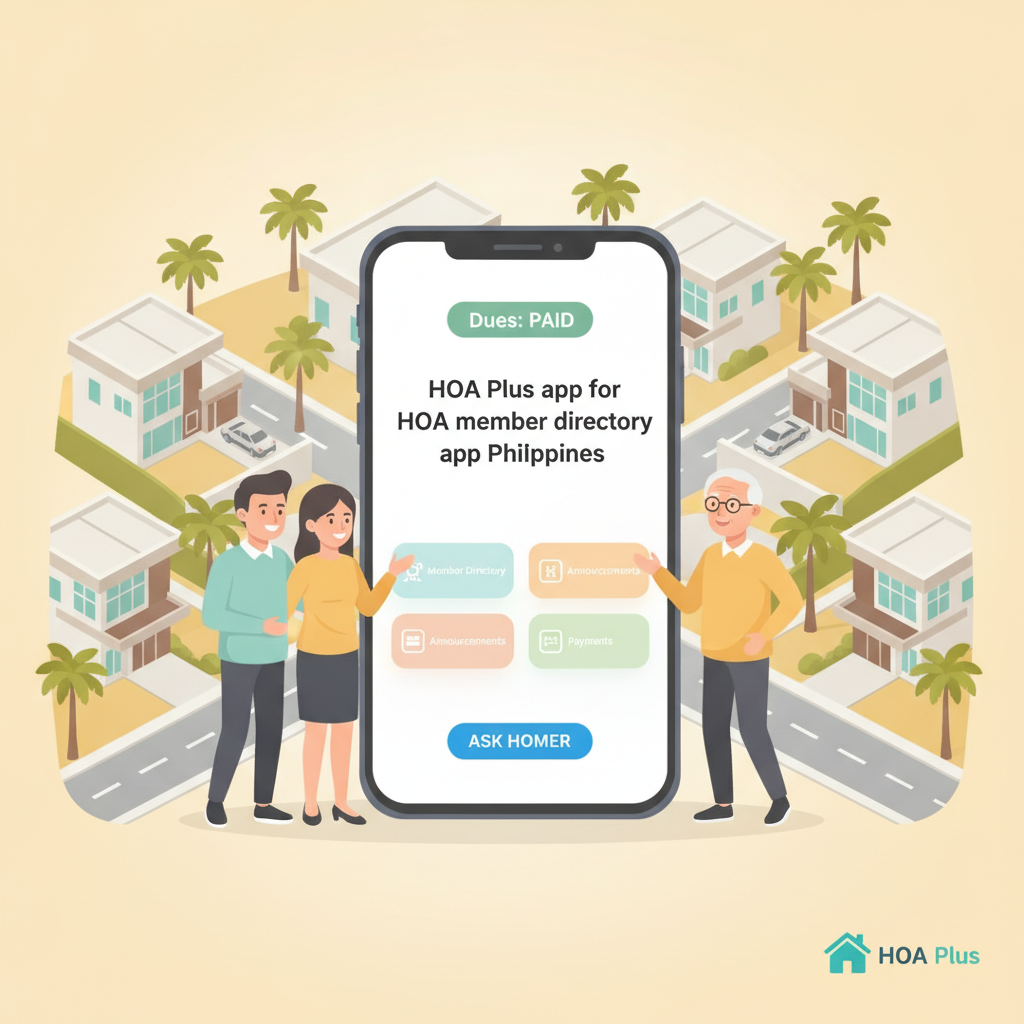
Forget spreadsheets. Forget photocopied lists handed out during annual meetings that everyone loses by February. A modern directory built into HOA Plus gives every resident their own secure profile. It includes their name, block and lot number, contact details, and household information. All of it is visible only to verified members of the subdivision.
Think of it like a private, community-only phonebook. In addition, it connects directly to other HOA Plus features. When a resident submits a maintenance request, the board can see exactly which homeowner submitted it and where they live — no guessing, no back-and-forth messages. When the board needs to send an important announcement, they can reach specific blocks instead of blasting the entire group chat.
Residents can update their own information. They can add household members. They can choose what is visible to other neighbors. Ultimately, each homeowner controls their own privacy while still being part of the community network.
The directory also removes the awkwardness of introductions. You can finally put a name to the face in Block 7. You can see that the woman with the Shih Tzu is your immediate neighbor and message her directly if her dog gets out. Furthermore, new residents can introduce themselves to the community without the pressure of posting in a chaotic group chat.
For more information about managing community records properly, visit the Department of the Interior and Local Government (DILG) for guidance on Philippine community governance standards.
Why This Matters for Everyday Homeowners
The member directory is not just a convenience feature. It solves real, everyday problems that subdivision residents face. Consider what happens when a package arrives while you are at work. Instead of the guard holding it and hoping you check the group chat, a neighbor can check the directory and send you a private message. Meanwhile, the package gets secured instead of sitting at the gate.
Consider what happens during an emergency. A water pipe bursts on your street at midnight. With an HOA member directory app Philippines communities trust, you can quickly message everyone affected. You do not need to wait for the board president to wake up and check their phone. You do not need to post in the group chat and hope the right people see it. You simply open the directory, find your block neighbors, and send a group message.
For elderly residents who may not be comfortable with complicated apps, the directory makes life simpler. Their family members can add them to the household profile. Neighbors can check on them during typhoon season. The directory becomes a safety net — not because it monitors anyone, but because it makes caring for each other easier.
This is exactly what an HOA member directory app Philippines subdivisions rely on delivers. It turns neighbors from strangers into a real support system. Nevertheless, it does so without forcing anyone into group chats or social media they do not want to join. Subdivision GC etiquette matters, but a proper directory means fewer things need to go through the group chat in the first place.
Why Board Members Love the Directory
Board members spend an enormous amount of time on communication. They chase down contact information. They update lists manually. They deal with residents who claim they never received an important notice. For this reason, a built-in directory transforms how the board operates.
Every resident’s profile includes their contact status. The board can see at a glance who has verified their information and who has not. They can send targeted messages to specific blocks or the entire community. They can track household changes — new renters, sold properties, additional family members — without anyone filling out a paper form.
The directory integrates with other HOA Plus tools naturally. When a resident submits a dues payment, the board sees it linked to that homeowner’s profile. Meeting attendance can be tracked. Security incidents can be logged by location. In other words, the directory becomes the foundation that every other community management function builds upon.
Most importantly, the directory reduces conflict. Many neighbor disputes start because people do not know how to reach each other directly. A noise complaint that could be resolved with a polite private message instead becomes a public argument in the group chat. A parking issue that needs a five-minute conversation turns into resentment that simmers for months. The directory gives neighbors a direct line to each other — the simplest way to prevent small problems from becoming big ones.

Privacy Without Paranoia
Any conversation about directories raises the same question: is my information safe? Homeowners in the Philippines are understandably cautious. Similarly, nobody wants their phone number broadcast to strangers or their household details visible to anyone who visits the subdivision website.
HOA Plus solves this with strict privacy controls built directly into the HOA member directory app Philippines standards demand. Only verified residents of your specific subdivision can view the directory. You choose what information is visible. You can hide your phone number while still being reachable through the app. You can display only your name and block number if that is what you prefer. Meanwhile, the board maintains a complete record for administrative purposes — separate from what neighbors can see.
This balance between transparency and privacy makes the directory work. Residents feel safe participating. The board has the information they need. No one feels exposed. Consequently, adoption rates are higher because homeowners trust the system.
Getting Started Takes Minutes
Setting up a member directory sounds like a massive undertaking. For most HOAs, it would mean surveying every household, collecting forms, and manually entering data into a spreadsheet that is outdated within a month. HOA Plus changes this completely.
When your subdivision onboards with HOA Plus, every homeowner receives an invitation to create their profile. The initial setup includes basic information from the association’s records. After that, residents simply verify and update their details. Specifically, they can add household members, upload a photo, and choose their privacy settings — all from their phone in under five minutes.
New residents moving into the subdivision are added automatically. Former residents are archived. The directory stays current without anyone needing to manually maintain it. Therefore, the board can finally stop being the middleman for every neighbor-to-neighbor introduction.
A strong HOA member directory app Philippines communities implement today creates the kind of neighborhood where people actually know each other — not just as faces, but as real neighbors who can help each other when it matters. Ultimately, that is what makes a subdivision feel like home.
Ready to connect your community? Visit hoa-plus.app and see how the HOA Plus directory can bring your neighbors together — without the awkwardness.