
HOA Accreditation Philippines: A Simple Guide
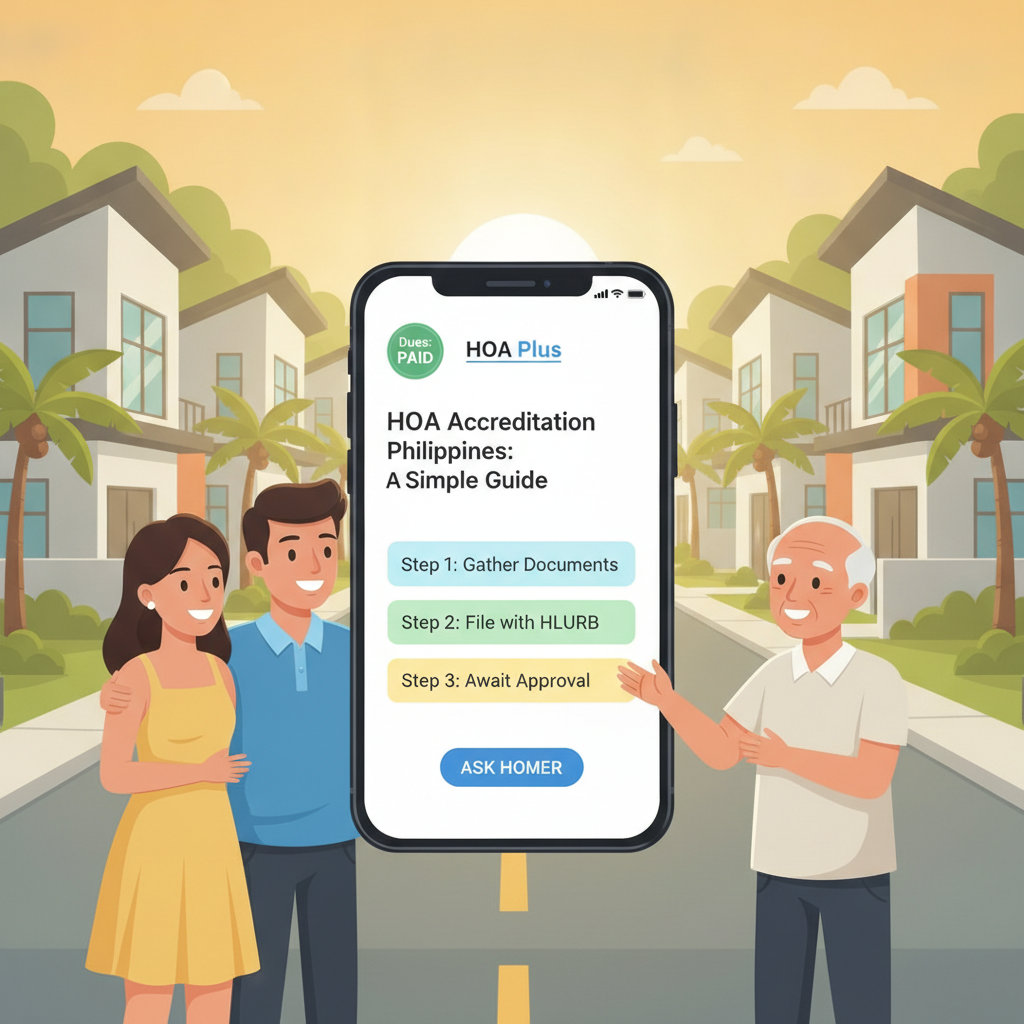
HOA Accreditation Philippines: A Simple Guide for Your Subdivision
Your homeowners association needs HOA accreditation to gain official legal standing in the Philippines. Without it, your association cannot fully collect dues, sign contracts, or enforce its rules in a lawful way.
Many boards skip this step because it sounds complicated. Some assume that simply electing officers makes them official. Consequently, they run into trouble later when a resident questions their authority. The good news is that HOA accreditation follows a clear, simple process.
This guide walks you through what HOA accreditation means and why it matters. It also shows how to complete the process step by step.
What Is HOA Accreditation in the Philippines?
HOA accreditation is the formal process of registering your homeowners association with the government. When your association completes it, the government recognizes you as a legal, official group.
Think of it as your association’s birth certificate. It proves your HOA exists in the eyes of the law. In other words, it turns a group of neighbors into a real organization with real responsibilities.
Accreditation falls under RA 9904, the Magna Carta for Homeowners. You can read our guide to RA 9904 explained for the full background.
Before accreditation, your board may collect dues informally. Afterward, you hold the legal right to manage the subdivision and represent every homeowner.
Why HOA Accreditation Matters
HOA accreditation gives your association real power. For example, an accredited HOA can open a bank account under its own name and enter into binding contracts.
It also protects the board. When your association holds official status, officers act on behalf of a recognized body. Therefore, individual members carry far less personal risk.
Most importantly, accreditation builds resident trust. Homeowners pay dues more willingly when they see a legally registered association managing their money. Furthermore, banks and vendors take you seriously.
Banks also treat an accredited HOA differently. Your treasurer can open accounts, sign agreements, and receive payments without a long explanation. In addition, that financial standing saves the board hours of paperwork.
Accreditation also shields individual officers from personal liability. When the association acts, it acts as a registered group. Therefore, a dispute over a community project stays a community matter, not a personal one.
Without accreditation, every decision the board makes can face challenge. A resident can simply ask, “Who gave you the authority?” and the board may have no good answer.
Who Handles HOA Accreditation in the Philippines?
The Department of Human Settlements and Urban Development, or DHSUD, handles HOA accreditation. This agency previously sat under the old HLURB, which many boards still remember.
Your association files its papers with the DHSUD regional office. Every region has its own office, and each one provides a checklist of requirements. Ask for that checklist before you file. This small step prevents a rejected application and saves you a second trip.
You can visit the official DHSUD website to confirm the latest requirements and fees. Requirements sometimes change, so checking the official source protects you.
The local barangay may also ask for your accreditation papers. Similarly, the city hall often requires proof before it processes permits for community projects.
The Steps to Get Your HOA Accredited
HOA accreditation follows a straight path. First, gather your association’s founding documents, including the articles of incorporation and your bylaws.
Second, prepare your board resolution. This document authorizes the filing and names the officers who will represent the association.
Third, collect the list of members and the lot certificates for each unit. The agency uses these to verify that your association truly represents the community.
Fourth, pay the filing fee and submit everything to the DHSUD regional office. Then you wait while the agency reviews your papers. Expect the review to take a few weeks. Keep your copies organized while the board continues its day-to-day work.
Finally, the agency issues your certificate once you pass the review. Keep this certificate safe. You will need it for banks, permits, and future renewals.
Read our guide on how to start an HOA in the Philippines if you have not formed your association yet.
Common HOA Accreditation Mistakes to Avoid
Boards often stumble on the small details of HOA accreditation. For instance, many file with incomplete member lists or outdated bylaws. Consequently, the agency sends the papers back and the process drags on.
Another common mistake is skipping the board resolution. Without it, the agency cannot confirm which officers hold authority to act. In short, missing paperwork costs you weeks.
Some boards also forget to renew. Accreditation requires periodic renewal, and the deadline slips by unnoticed. Meanwhile, the association continues operating without fresh documents.
Set a reminder for every renewal date. Then assign one officer to own the paperwork from start to finish. This single habit prevents most delays.
What Happens After You Get Accredited
Once your association completes HOA accreditation, life gets easier in several ways. You can now open a proper bank account and receive dues cleanly.
Your board can also sign contracts for security, maintenance, and landscaping. Vendors respond faster when they deal with a registered group. In turn, projects move forward without friction.
Accreditation also unlocks official meetings. You can hold a valid general assembly, elect officers, and pass resolutions that carry legal weight. Read our guide to the HOA general meeting for the full checklist.
Finally, your association can represent the community with the barangay and the city government. That official standing opens doors that informal groups simply cannot reach.
A registered association also handles leadership changes smoothly. When a new board takes over, the paperwork, bank accounts, and contracts all transfer cleanly. In short, accreditation keeps your community organized through every election season. Banks, vendors, and city officials all respond faster to a group with official papers.
How HOA Plus Helps Your Accredited HOA
Accreditation earns you the legal right to manage. HOA Plus helps you actually do the managing well. The app keeps your dues, documents, and announcements in one calm place.
Residents open the app to see where their money goes and what the board is doing. You can ask HOMER any question about your rules and get an answer in seconds. Consequently, fewer people bother the board with the same old questions.
The board also saves hours. Instead of chasing paper and group chats, you post updates once and everyone sees them. Meanwhile, dues tracking and reports stay clean and transparent.
An accredited, organized association earns the community’s respect. Ultimately, that trust is what keeps a subdivision peaceful.
New officers can also pick up where the old ones left off. The app stores your records, so nothing disappears when a treasurer steps down. Consequently, your accredited HOA stays steady even when people change.
Start Your HOA Accreditation Today
HOA accreditation is not as hard as it sounds. It simply asks your board to gather a few documents, file them with DHSUD, and keep the certificate safe.
Begin this week. Assign one officer to collect the papers, set a filing date, and check the official requirements. The sooner your association earns its status, the sooner it can manage with confidence.
Try HOA Plus free for your community and manage your accredited HOA with ease.