
HOA Budgeting 101: Where Should Your Subdivision’s Dues Actually Go?
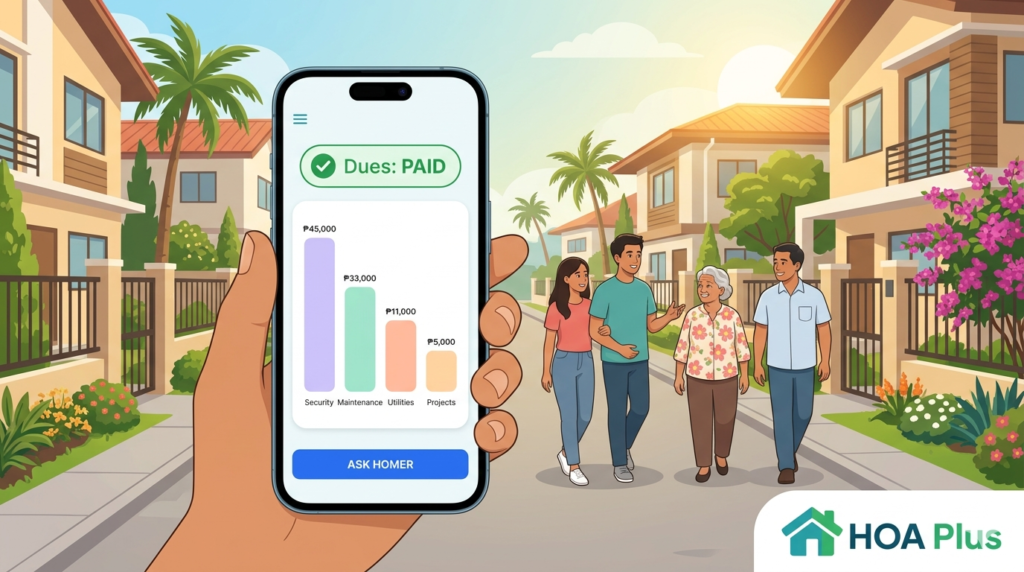
Every Filipino homeowner has asked it at one point or another: “Saan ba talaga napupunta ang HOA dues namin?” A good HOA budget Philippines residents can trust isn’t a mystery hidden in the treasurer’s notebook — it’s a clear plan that says exactly how every peso gets allocated, spent, and reported. Yet most subdivisions still run on guesswork, a fading printed budget from three years ago, and whatever the board can remember during the meeting.
This is the guide we wish every new HOA board member, treasurer, and frustrated homeowner had on day one. If your subdivision feels like dues just disappear into a vague “maintenance fund,” start here.
Why Most HOA Budgets in the Philippines Fail
Most subdivision budgets fail for the same three reasons: they’re not written down anywhere homeowners can see, they’re not based on real expense history, and they get blown off-track the first time something breaks. The board ends up making spending decisions in the group chat at midnight, the treasurer scrambles to balance the books at year-end, and residents stop trusting the numbers entirely.
A working HOA budget isn’t a one-time annual document — it’s a living plan that gets revisited every month. When residents can see the plan and the actuals side by side, the “where did our dues go” question stops getting asked. (For the deeper story on why this transparency matters, see our guide on where your HOA dues actually go.)
What an HOA Budget Philippines Actually Covers
A proper HOA budget Philippines subdivisions can rely on covers four things at minimum: recurring expenses, one-time projects, reserves, and revenue forecasts. Recurring expenses are predictable — security, garbage collection, utilities. One-time projects are the big-ticket items like repainting the perimeter wall or replacing the clubhouse aircon. Reserves are your sinking fund for emergencies. Revenue is what dues collection and other income will realistically bring in.
Skip any one of these four, and the budget breaks down. A budget with no reserves panics every typhoon season. A budget with no project line items quietly cannibalizes the maintenance fund. A budget with no revenue forecast assumes 100% collection — which never happens in real life.
The 6 Main Categories of an HOA Budget Philippines Boards Should Track
Every HOA budget Philippines homeowners deserve to see should break down into six clean buckets. Different villages use different labels, but the categories are universal:
- Security and Safety — guard salaries, gate equipment, CCTV maintenance, ID systems. Often the single largest line item, sometimes 35-45% of total dues.
- Maintenance and Repairs — landscaping, road patching, streetlight replacement, common-area upkeep. Usually 15-25%.
- Utilities and Services — water for common areas, electricity for streetlights, garbage collection, internet for the guardhouse. Around 10-15%.
- Administration — bookkeeping software, printing, board meeting expenses, audit fees, government registration costs. Should stay under 10%.
- Projects and Improvements — anything beyond regular maintenance: new amenities, beautification, paving. Variable, but should always have a line.
- Reserves and Contingency — the safety net. Aim for at least 10% of the annual budget going into reserves until you have 3-6 months of operating expenses saved.
If your subdivision has never published this breakdown, you don’t really have a budget — you have a spending log. (For accountability on the spending side, our post on HOA project tracking shows how to make those project line items visible to everyone.)
How Much Should HOA Dues Actually Cost?
This is the question every new homeowner asks and almost no board can answer confidently. The honest answer: HOA dues depend on what your community actually needs to operate — not on what neighboring subdivisions charge.
A useful starting point is to work backwards from the budget. Add up your six categories for the year, divide by the number of paying units, divide by 12, and that’s your monthly dues floor. If the math gives you ₱1,200/month per unit but the board is collecting ₱600, you have a structural deficit no amount of fundraising will fix. If the math says ₱800 and you’re collecting ₱2,000, residents are subsidizing a slush fund.
The Magna Carta for Homeowners’ Associations (RA 9904) requires associations to set dues in line with actual operating needs and to disclose how they’re used. A budget makes that disclosure possible. (Our breakdown of RA 9904 covers the full legal framework.)
Building a Realistic HOA Budget Philippines Boards Can Actually Defend
Drafting an HOA budget Philippines residents will accept isn’t complicated — but it does require discipline. Here’s the basic sequence every treasurer should follow:
- Pull last year’s actual spending — not the budget, the actuals. If the budget said ₱200,000 for security but you spent ₱260,000, that’s reality.
- Adjust for known changes — minimum wage increases for guards, new utility rates, contracts coming up for renewal.
- List every project planned for the year — with estimated costs, even rough ones.
- Project your revenue conservatively — assume 80-85% collection unless your historical rate says otherwise.
- Reserve at least 10% for contingency — typhoons, surprise repairs, legal fees.
- Publish it — to every homeowner, not just board members.
Step 6 is where most subdivisions stop. They build a beautiful spreadsheet and email it to the board, never to residents. That’s exactly how distrust starts.
Common HOA Budget Mistakes That Wreck Subdivisions
Even well-intentioned boards stumble in predictable ways. Watch for these:
Confusing operating expenses with capital projects. Fixing the gate is operating. Replacing the entire gate system is capital. Mixing them makes both invisible.
Underbudgeting security. Guard salaries, 13th month pay, SSS contributions, training, and uniforms add up fast. A budget that only counts base salary will blow up by Q2.
Zero reserves. A subdivision with no contingency line is one broken transformer away from a special assessment that residents will hate paying.
No mid-year review. Budgets aren’t sacred. If your security cost jumped 20%, the budget has to flex. Most boards only revisit the budget at the annual meeting — by then, the year is over.
Treating dues collection as someone else’s problem. A budget assuming full collection without a real collection process is fiction. (For how to handle the collection side without ruining neighbor relationships, see our HOA board member duties guide.)
How HOA Plus Makes Your HOA Budget Philippines Actually Transparent
HOA Plus is built around the idea that the budget shouldn’t live in a treasurer’s laptop. Every feature in the app is designed to make the budget visible, defensible, and easy to track month over month:
- Transparent billing — every homeowner sees their own ledger, payment history, and what’s outstanding. No more “may bayad pa ako ba?” debates.
- Collection health dashboard — boards see in real time what percentage of dues has actually come in, broken down by month.
- Project tracking with budgets — every capital project gets a budget, a target completion date, and uploaded receipts homeowners can scroll through.
- Community Vitals — publish the headline financial numbers (collection rate, reserves balance, project spend) on the home screen so every resident sees them.
- Audit trail — every admin action involving money gets logged. No mysterious withdrawals.
- Document Vault — your full annual budget, audited financials, and board resolutions live in one searchable place. (More on this in our HOA document management guide.)
None of these features alone build a good budget. What they do is make a good budget impossible to hide and a bad one impossible to disguise.
Build a Better HOA Budget for Your Subdivision This Quarter
You don’t need a CPA to fix your HOA budget Philippines homeowners can finally trust. You need three things: a real list of expenses, a realistic revenue projection, and somewhere visible to publish both. The villages that get this right collect more dues, have fewer fights, and stop hemorrhaging board members to burnout.
Ready to make your subdivision’s finances visible without printing 200 pages of statements? Try HOA Plus free for your community and start running an HOA budget Philippines residents will actually defend.