
10 Signs You Live in a Well-Managed Subdivision (And How to Get There If You Don’t)
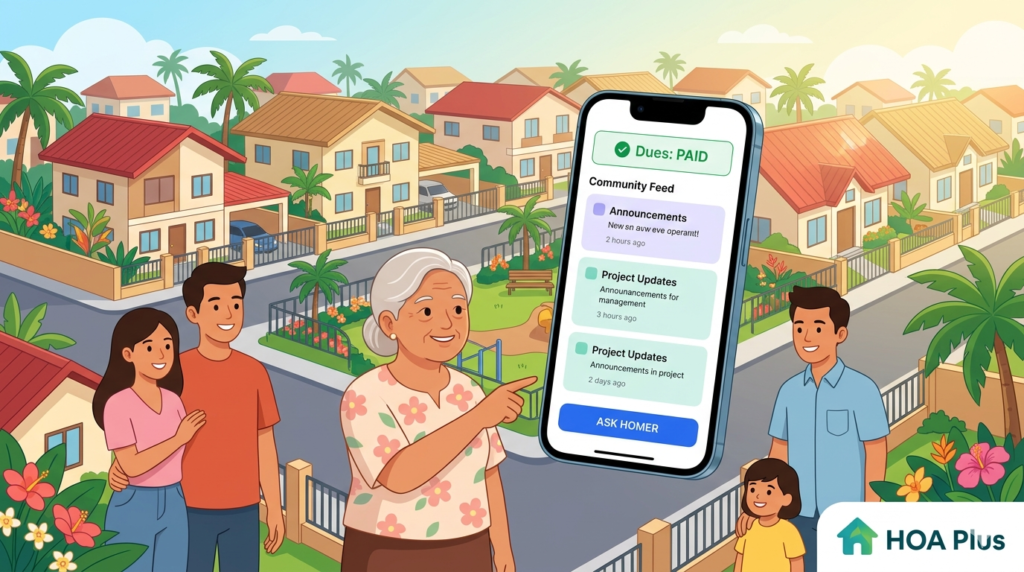
You can usually tell within a week of moving in whether you’ve landed in a well-managed subdivision or one that runs on prayers, group chat arguments, and “kuya, paki-asikaso na lang.” The streets are quieter. The Viber group is calmer. Nobody is shouting about double-booked clubhouses or missing dues receipts.
If your community feels like the opposite — endless complaints, unclear bills, and a board that’s always one resignation letter away from collapse — this guide is for you. Here are the 10 unmistakable signs of a well-managed subdivision in the Philippines, plus what to do if yours is missing a few of them.
What Does a Well-Managed Subdivision Look Like Day-to-Day?
A well-managed subdivision isn’t one that never has problems. Every community has noisy neighbors, parking arguments, and the occasional broken streetlight. The difference is how those problems get handled. In a well-run village, issues surface early, get logged somewhere visible, and get resolved without dragging 400 homeowners into a 200-message Viber thread.
The signs below aren’t fancy amenities or imported landscaping. They’re the small, repeatable habits that make community life feel calm instead of chaotic. Tick off as many as you can — and pay attention to which ones your subdivision is missing.
Signs 1–3: Transparency, Information Flow, and Clear Rules
1. You Know Exactly Where Your Dues Go
In a well-managed subdivision, dues transparency isn’t a once-a-year mystery revealed at the annual general meeting. Homeowners can see — at any time — what was collected, what was spent, and on which project. No “trust me po” accounting. No suspicious cash withdrawals. Just a clean, ongoing record everyone can check from their phone.
If you’re not sure where your dues are going right now, that’s a red flag. (For a deeper look at this issue, see our guide on where your HOA dues actually go.)
2. Information Lives in One Place — Not in 14 Group Chats
One of the clearest markers of a well-managed subdivision is that residents don’t have to scroll through 800 unread Viber messages to find out when garbage collection moved or whether the water interruption is fixed. Announcements live on a proper community feed, sorted by date, searchable, and free of “kuya may issue ba sa tubig?” chaos.
If your village’s only communication channel is a hostile group chat, even good news gets lost in the noise.
3. Bylaws Are Easy to Find — Not Buried in a 50-Page PDF
You shouldn’t need a law degree (or a friend on the board) to find out whether you’re allowed to repaint your gate. A well-run HOA makes its rules searchable and accessible to everyone. Better yet, the bylaws should answer questions in plain Filipino-English, not legalese. (Our post on searching your bylaws in seconds with HOMER shows what this looks like in practice.)
Signs 4–6: Smooth Operations in a Well-Managed Subdivision
4. Facility Bookings Don’t Trigger Fights
The clubhouse, basketball court, and function hall in a well-managed subdivision are booked through a clear system — not by texting Tita Admin at 11pm and hoping she remembers. Everyone can see what’s reserved, when, and by whom. Double-bookings disappear. So do the petty Viber wars about whose kid’s birthday came first.
5. Conflicts Get De-Escalated, Not Amplified
Disputes happen everywhere — noisy parties, parking encroachments, dogs barking past midnight. The difference in a well-managed subdivision is that complaints don’t go straight to a public group chat where 300 people read them and pick sides. There’s a calmer, more private way to raise concerns, and someone (or something) helps reword angry messages into neutral ones before they detonate.
If your community defaults to public shaming, it’s not well-run. It’s just loud.
6. Projects Have Budgets, Timelines, and Receipts
“Saan napunta yung budget for the gate?” should never be a recurring question. In a well-managed subdivision, every major project has a published budget, a target completion date, an updated progress percentage, and uploaded receipts. Homeowners can follow along the same way you’d track a delivery on Lazada.
For a closer look at how this works, see our breakdown of HOA project tracking.
Signs 7–8: Safety and Recognition
7. Emergency Plans Exist Before You Need Them
In a well-managed subdivision, you don’t have to scramble to find the on-call electrician’s number during a brownout, or guess which hospital is nearest during an emergency. Contacts for police, fire, hospital, and the HOA office are one tap away. Active alerts — typhoon prep, water interruption, security incident — show up where residents will actually see them, not buried in chat scrollback.
If your only emergency plan is “tawagan natin si Kuya Guard,” you’re one bad night away from a real problem. (Our HOA emergency preparedness guide covers the full checklist.)
8. Good Neighbors Get Recognized, Not Just Complainers
Every community has people who quietly make it better — the retiree who waters the entrance plants, the guard who remembers everyone’s car, the teenager who helps lolas carry groceries. In a poorly-run village, nobody notices. In a well-managed subdivision, there’s a way to publicly thank them — a “Neighbor of the Month” feature, a commendations board, something visible. Positive reinforcement is contagious. So is negativity, which is why so many villages feel toxic by default.
Signs 9–10: Decision-Making and Trust
9. Meetings Produce Decisions, Not More Arguments
HOA meetings in a well-run village have clear agendas, hit quorum, produce written minutes, and end with actual decisions — usually decided by a fair vote that residents can verify later. They don’t drag on for four hours, dissolve into shouting matches, or get postponed three times because nobody RSVP’d. (See our complete HOA general meeting guide for what a good one looks like.)
10. Residents Trust the Board — And the Board Trusts the System
The ultimate sign of a well-managed subdivision is that homeowners genuinely believe their board is doing the right thing — and the board doesn’t have to spend half its waking hours defending itself in the group chat. Trust comes from transparency: visible dues, visible projects, visible decisions, visible audit trails. When everything is logged and viewable, conspiracy theories starve to death.
The Common Thread in Every Well-Managed Subdivision
Notice what every sign on this list has in common: visibility. Dues are visible. Bookings are visible. Rules are visible. Projects are visible. Decisions are visible. Commendations are visible. Emergencies are visible. When everyone can see what’s happening, drama has nowhere to grow.
That’s the whole reason the Magna Carta for Homeowners’ Associations (RA 9904) emphasizes transparency, accountability, and homeowner participation — it’s not bureaucratic checkbox-ticking. It’s how communities stay sane.
How HOA Plus Builds a Well-Managed Subdivision From Day One
HOA Plus is built around one idea: a community-first app that prioritizes harmony and transparency over enforcement. Every sign on this list maps directly to something your subdivision can switch on this week:
- Dues transparency — every homeowner sees their own ledger and the community collection health dashboard.
- Community feed — replaces the chaotic Viber GC with a searchable, sortable announcement hub.
- Bylaw search with HOMER — ask a question in plain language, get the exact bylaw section with a citation.
- Facility booking — time-slot reservations, admin approvals, zero double-bookings.
- AI Mediator — neutralizes the tone of complaints and reports before they go public.
- Project tracking — budgets, milestones, expense receipts, all in one place.
- Emergency Central — tap-to-call contacts and live alerts on the home screen.
- Neighbor commendations — publicly recognize the people quietly making your subdivision better.
- Audit trail — every admin action is logged. No “sino nag-approve nito?” mysteries.
These aren’t future promises. They’re already live inside HOA Plus communities across the Philippines.
Turn Yours Into a Well-Managed Subdivision This Month
You don’t need a new board, a new bylaw rewrite, or a million-peso facelift to become a well-managed subdivision. You need visibility — and the right tool to make that visibility effortless. Most villages that switch see the Viber drama drop within the first month, simply because residents finally have somewhere calm to look.
Ready to see what a calmer community feels like? Try HOA Plus free for your community and start ticking off the signs of a well-managed subdivision — one feature at a time.