
HOA Covenants Philippines Guide | HOA Plus
Understanding HOA Covenants in the Philippines: What Every Homeowner Needs to Know
HOA covenants Philippines are the foundation of every well-run subdivision. But most Filipino homeowners have never read theirs. These rules shape what you can build and how you can use your property. They also guide what happens when neighbors disagree about fence heights or parking spaces.
If you bought a home in a subdivision, you agreed to follow these covenants. This is true whether you knew it or not. Understanding them helps you know your rights as a homeowner. It also helps you make sure your board enforces the rules fairly for everyone.
What Are HOA Covenants in the Philippines?
HOA covenants Philippines refer to the written rules that govern life inside a subdivision. People call them by many names. Some say deed restrictions, others say community bylaws, and many just call them “the subdivision rules.” In legal terms, these covenants are binding agreements that run with the land. This means they apply to every owner, not just the first buyer.
When a developer creates a subdivision, they register these covenants with the Register of Deeds. The rules become part of your property title. Therefore, every homeowner who buys a lot in that subdivision accepts the covenants. You cannot opt out just because you did not read them.
Most covenants cover common areas of daily life. These include building height limits, fence styles, paint colors, and pet rules. They also cover noise limits and business use inside the subdivision. For example, your HOA covenants Philippines may say you cannot build a second story without board approval. They may also say you cannot run a commercial bakery from your garage.
Why Do HOA Covenants Exist?
Many homeowners ask why they need so many rules about their own property. The answer is simple. Covenants protect property values and community peace for everyone who lives there.
Think about what could happen without rules. Your neighbor might build a four-story building that blocks your sunlight. Someone could open a 24-hour repair shop next door and bring noise to your quiet street. Without HOA covenants Philippines, nothing stops these things from happening.
Furthermore, covenants create order. When every homeowner follows the same building and usage rules, the subdivision keeps its look and feel. This consistency is what makes buyers want to live there. It is also what keeps property values strong over time. Consequently, covenants help every resident, even those who find them annoying at times.

Where to Find Your HOA Covenants
If you have never seen your subdivision covenants, you are not alone. Many Filipino homeowners never get a copy when they buy their home. However, finding your HOA covenants Philippines is easier than you might think.
Start with your HOA board or property manager. They must keep a copy of the governing documents. They should give one to any homeowner who asks. Similarly, you can check with the developer if they still manage the subdivision.
For a more formal path, visit the Register of Deeds where your title was filed. The covenants are attached to the mother title of the subdivision. Specifically, you can ask for a certified true copy of the note on your title that mentions the deed restrictions. Additionally, many Philippine subdivisions now upload their covenants to the HLURB (Housing and Land Use Regulatory Board) or its successor, the DHSUD.
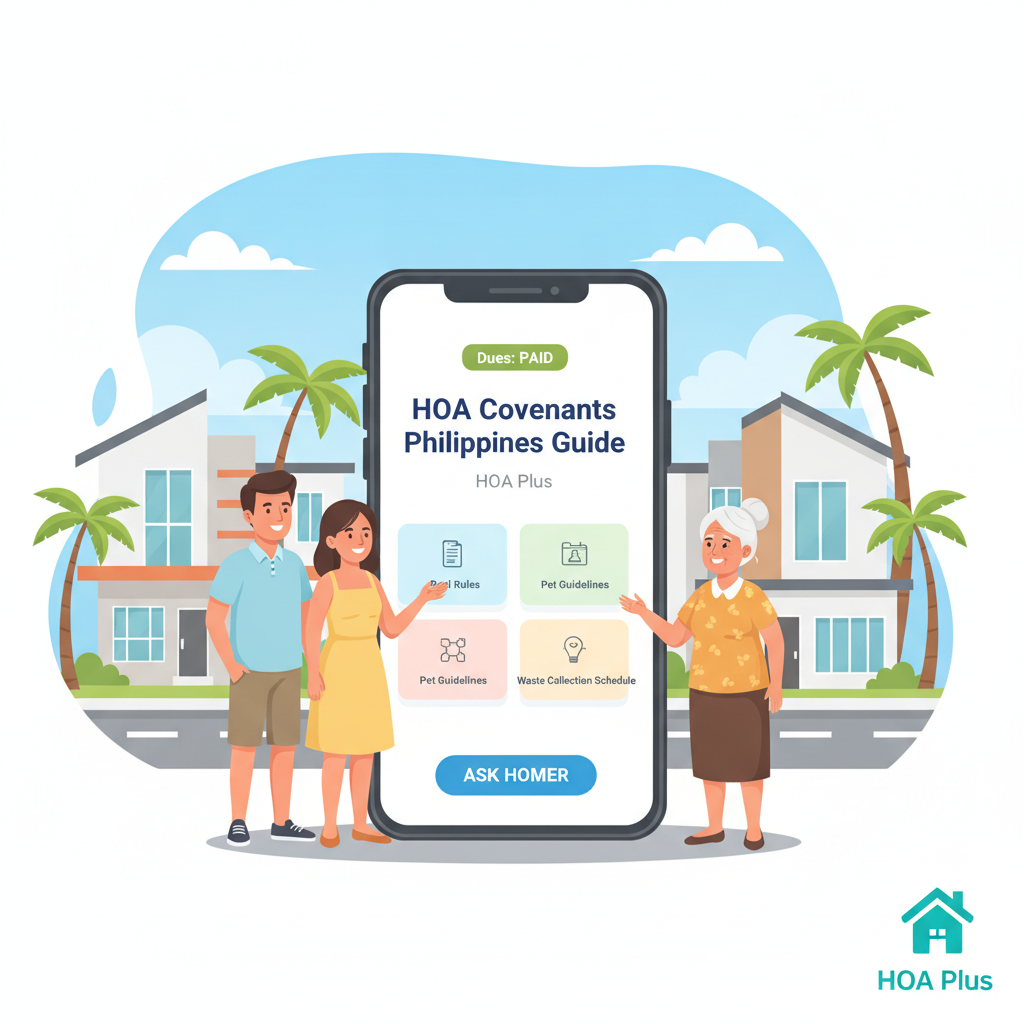
If your HOA uses a digital platform like HOA Plus, the governing documents sit in the Document Library. You can open them anytime from your phone. No need to dig through folders or visit a government office.
What HOA Covenants Philippines Typically Cover
Every subdivision writes its own rules. But most HOA covenants Philippines cover the same core topics. Knowing these categories helps you understand what to look for in your own community documents.
Building and Construction Rules: These set how far your house must sit from the property line. They also limit building height, roof materials, and exterior paint colors. For example, your covenants may require a minimum lot size for building. They may also ban certain materials that do not match the community look.
Property Use Restrictions: These rules spell out what you can and cannot do on your property. Common limits include bans on running a business from home. They also limit how many cars you can park on the street and what signs you can put up. In addition, many HOA covenants Philippines restrict short-term rentals like Airbnb unless the board says yes.
Pet and Animal Rules: Most subdivisions cap the number, size, and breed of pets you can keep. These rules also cover leashes, waste cleanup, and noise from animals. For a deeper look at this topic, see our guide on subdivision pet rules in the Philippines.
Common Area Usage: Covenants set who can use the clubhouse, pool, basketball court, and other shared spaces. They also cover guest limits, booking rules, and fees for damage or overuse.
Dues and Assessments: Your covenants spell out how monthly HOA dues get calculated and when you must pay. They also explain what happens when a homeowner falls behind. Furthermore, the rules cover special assessments — one-time charges for big repairs or upgrades. Read our guide to HOA dues transparency for more detail.
How HOA Covenants Are Enforced
Your HOA board has the legal power to enforce HOA covenants Philippines under Republic Act 9904. This is the Magna Carta for Homeowners and Homeowners Associations. The law lets the board send violation notices and set fines. In serious cases, the board can even file legal action against homeowners who refuse to follow the rules.
However, enforcement should always start with a friendly talk. Most violations happen because the homeowner does not know the rule exists. They are not trying to cause trouble. Therefore, a good board begins with a polite note. The note explains the specific covenant being broken and how to fix it.
If the homeowner still does not comply after a written notice, the board can go further. The next steps move to mediation, then to fines, and finally to legal action if nothing else works. Nevertheless, most Philippine HOAs settle covenant disputes long before they reach a courtroom.
The secret to fair enforcement is being the same with everyone. If the board lets one homeowner slide but fines another for the same thing, they lose trust. They may also face legal trouble. Consequently, every HOA board must apply HOA covenants Philippines the same way to every resident. Personal friendships should not matter.
Can HOA Covenants Be Changed?
Yes — HOA covenants Philippines can be changed. But the process is not simple. Most covenants need a supermajority vote of the members to pass an amendment. Often this means two-thirds or even three-quarters of all homeowners must agree. This high bar exists to stop a small group from rewriting the rules without broad support.
The amendment process usually follows these steps. First, a proposal is drafted and shared with all members. Then a general assembly is called with proper notice. The members vote, and if the supermajority says yes, the amendment gets registered with the right government offices. Similarly, the updated covenants must be noted on every title. This process takes time and teamwork.
For example, say your subdivision wants to allow solar panels. But the old covenants banned them to keep a uniform look. The members can vote to change the rule. However, getting enough votes often needs a long campaign of teaching and talking to neighbors one by one.
If your HOA board wants to amend the covenants, our guide on how to amend HOA bylaws in the Philippines walks through every step.
What Happens When There Are No Covenants?
Some older subdivisions in the Philippines run without formal HOA covenants Philippines. Others have rules so old that nobody follows them anymore. At first glance this might sound like freedom, but the truth is often messy.
Without clear covenants, fights multiply. One neighbor paints their house neon pink. Another builds a structure that crosses the property line. The board has no legal ground to step in. Every disagreement turns into a personal battle instead of a rule-based choice. Ultimately, property values in these areas tend to drop. Buyers pick governed subdivisions because they like knowing what to expect.
Furthermore, without covenants, an HOA cannot require dues from everyone. This means no funds for security guards, street lights, garbage pickup, or common area care. The subdivision slowly falls apart, and everyone pays the price.
If your community lacks proper covenants, the first step is to gather your neighbors. Then reach out to the DHSUD for help on setting up formal governance papers. It is a long road, but the other path is worse.
Your Rights as a Homeowner Under HOA Covenants Philippines
While HOA covenants Philippines set limits, they also guard your rights. You have the right to get a copy of the covenants. You can attend board meetings where rules get discussed. You can vote on changes and big choices. And you can push back on enforcement actions that feel unfair or one-sided.
In addition, the law says all covenant enforcement must be fair and measured. A board cannot hand out fines or penalties that the governing papers do not list. They cannot dream up new rules without going through the proper amendment steps. And they absolutely cannot play favorites — covenants must apply the same way to everyone.
If you think your HOA is enforcing rules the wrong way, start by writing everything down. Save copies of violation notices, snap photos, and ask for answers in writing. Then bring your concern to the next board meeting or general assembly. Most problems get solved at this level when homeowners state their case calmly with proof in hand.
The Bottom Line on HOA Covenants Philippines
HOA covenants Philippines are not just boring paperwork. They are the rulebook for your community. They shape what your subdivision looks like. They guide how neighbors treat each other. And they decide whether your property keeps or loses value as the years go by.
Take 30 minutes this week to find and read your subdivision covenants. Ask your board for a copy or check your title papers. If your community uses the HOA Plus platform, the Document Library has everything ready on your phone. Knowing the rules is the first step to being a smart, confident homeowner. Do not wait to learn about the covenants only when a violation notice lands in your hand.
Ready to bring clarity and order to your HOA? Try HOA Plus free for your community — and give every homeowner quick access to covenants, bylaws, and all the papers that matter.