
HOA Member Rights in the Philippines Explained
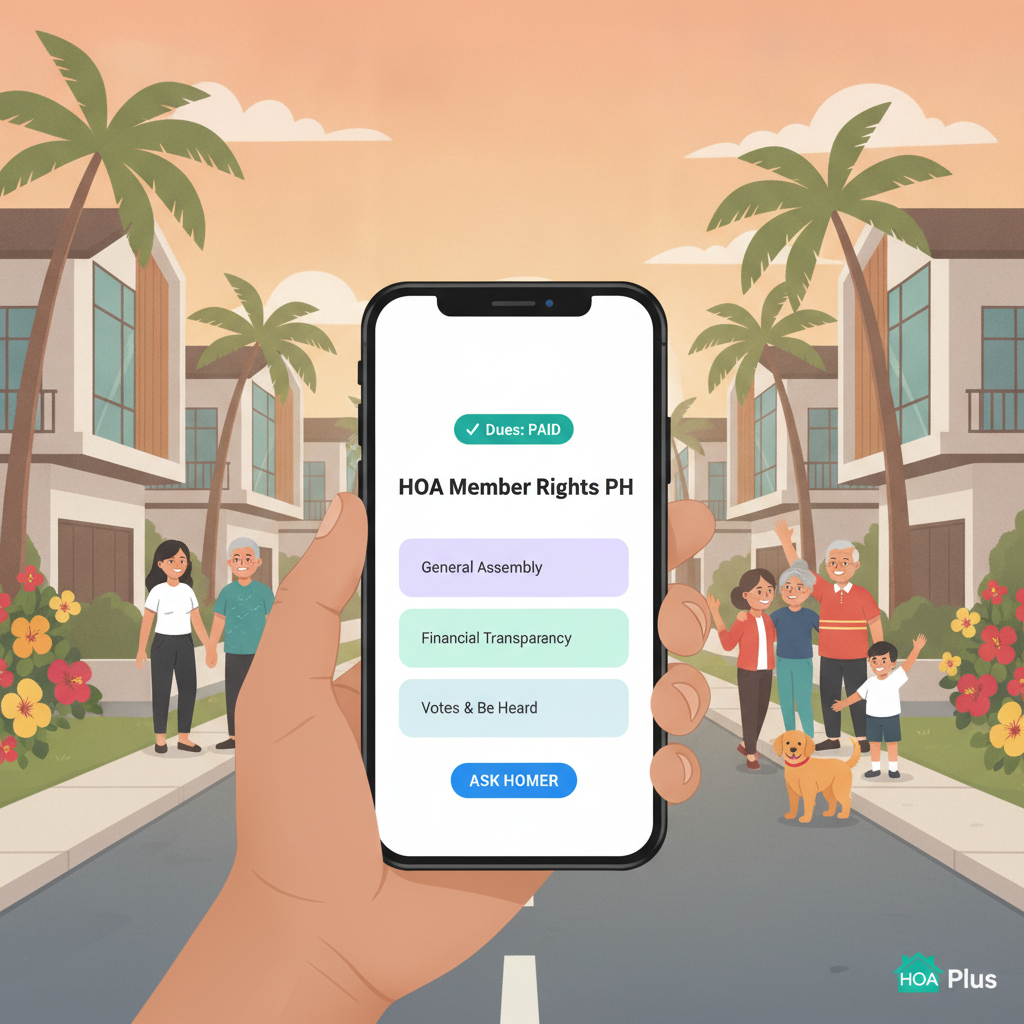
HOA Member Rights in the Philippines Explained
Your HOA member rights matter far more than most Filipino homeowners realize. You pay your dues on time and follow every subdivision rule, so you deserve to know exactly what you get in return.
The problem? Many boards never explain these rights. Homeowners feel powerless, unsure what they can ask for or how to push back when something feels wrong.
This guide walks you through the basics. It shows what the law gives you, what your board must provide, and how to raise a concern without turning your street into a battlefield.
None of this requires a law degree. You just need to know the few protections that already sit on your side of the gate.
What Are HOA Member Rights?
HOA member rights are the protections and benefits you hold simply by owning a home inside a homeowners association. They are not favors the board hands out. The law grants them to you.
These rights cover several areas. You can see the finances, vote on big decisions, and expect fair treatment when rules get enforced. For example, you have a right to know how the board spends your monthly dues.
In short, your HOA member rights include several clear protections:
- Inspect the financial records and see how dues get spent.
- Vote in elections and on major community decisions.
- Expect fair, consistent rules that apply to every home.
- Attend meetings and make your voice heard.
- Hold board members accountable for their duties.
Furthermore, these rights protect you from overreach. A board cannot change the rules overnight without notice, and it cannot pick favorites when it hands out fines.
If you are new to this world, start with our simple explainer on what an HOA is in the Philippines. It sets the stage for everything below.
HOA Member Rights Under RA 9904
The strongest source of your HOA member rights is a Philippine law called RA 9904. Lawmakers created it to bring order and fairness to homeowners associations across the country.
Specifically, this law sets out what a board must do. It requires transparent records, honest elections, and rules that apply to everyone equally. Therefore, your rights are not just nice ideas — the law backs them.
You can read the full text of the Magna Carta for Homeowners’ Associations on the Official Gazette website. It is the best place to check the exact wording.
Moreover, knowing this law changes how you approach your board. You stop asking for favors and start asking for what already belongs to you.
Confidence grows the moment you learn that fairness is a right, not a request.
The Right to See Where Your Dues Go
Every month you hand over dues money. Consequently, you hold a clear right to see where that money goes.
The board must keep honest records and share them with members. This includes the budget, the expenses, and any funds set aside for future repairs.
Ask for a clear breakdown. Your dues should cover security, upkeep, and community projects, and each item should carry a number. When you can trace every peso, doubt quietly disappears.
Digital tools make this far easier. Instead of a dusty ledger no one can read, a good system shows every resident the same clear numbers on their phone. That single view removes most suspicion before it starts.
In addition, you can ask for a financial report at any reasonable time. A healthy board welcomes this question instead of dodging it.
When finances stay hidden, distrust grows fast. However, a board that opens its books builds the trust that keeps a community calm.
Transparency is the cheapest conflict prevention a community can buy.
The Right to Fair and Consistent Rules
Rules only work when they apply to everyone. One homeowner cannot park on the sidewalk while another gets a fine for the same thing.
Your HOA member rights include fair treatment. The board must follow the same written rules for every home, from the first block to the last.
Similarly, new rules should follow proper notice and approval. A board cannot quietly add a new fee and start collecting it the next week.
Fairness also means equal penalties. A first offense should not cost one household more than the same offense costs another. Consistency here saves the board from endless arguments later.
For a deeper look at how rules should be handled, read our guide on fair HOA rules enforcement in the Philippines.
HOA Member Rights to Vote and Be Heard
You are a member, not just a name on a list. Your voice carries weight in the decisions that shape your street.
Therefore, you hold the right to vote on major matters. This includes elections for board seats, big spending projects, and changes to the governing rules.
Moreover, you can attend general meetings and speak your mind. A board that listens to members makes better choices for the whole community.
Meanwhile, if your board rarely holds meetings, something is wrong. The law expects regular, properly announced assemblies.
Show up and participate. When more members speak, the board hears the whole street, not just the loudest few voices. That balance is the heart of a healthy community.
What Your Board Must Provide You
Alongside your rights, your board carries duties. Understanding both sides keeps expectations clear and fair.
Your board must share notices, records, and meeting minutes. It must also collect dues fairly and spend them only on community needs.
Furthermore, board members owe you honesty. They must avoid conflicts of interest and make decisions for the whole subdivision, not for their own benefit.
Good boards also share meeting minutes and decisions promptly. When nothing stays hidden, rumors lose their power, and residents trust the people they elected.
If this sounds like a lot, remember that clear duties protect the board too. For a closer look, see our guide to HOA board member duties in the Philippines.
How to Raise a Concern Without the Drama
Knowing your HOA member rights is step one. Using them well is step two.
First, put your concern in writing. A short, polite message to the board creates a record and keeps emotions out of the room.
Second, bring it up at the next meeting. When members raise issues calmly and openly, boards almost always respond better.
Ultimately, most disputes end peacefully when both sides stick to the rules. Keep it respectful, and you keep the neighborhood peaceful too.
If a serious issue goes nowhere, remember that you can escalate. Document everything, gather other members who share the concern, and bring it up through the proper channels. Persistence plus politeness usually wins.
Know Your Rights, Keep the Peace
Your HOA member rights exist to protect your home and your money. When you understand them, you stop feeling powerless and start participating with confidence.
A good community runs on trust, not on secrets. Ask questions, attend meetings, and expect fairness — because the law already gives you that right.
Read your rules, follow the money, and show up to the meetings. A confident, informed homeowner makes the whole subdivision stronger.
Start today. Read one rule, ask one question, and watch how quickly the picture clears.
Try HOA Plus free and give your community a transparent home for rules, records, and updates.