
HOA Reserve Fund Philippines | HOA Plus
HOA Reserve Fund Philippines: Why Your Subdivision Needs One and How to Build It
Every subdivision in the Philippines needs an HOA reserve fund Philippines communities can rely on when major repairs become urgent, yet most communities do not have one until it is too late. You pay your monthly dues on time and your board keeps the streetlights on and the gate working. Everything seems fine — until the drainage system collapses during a typhoon and your board needs two million pesos that nobody has.
This scenario is more common than you think. An HOA reserve fund Philippines homeowners can count on is not a luxury. It is the single most important financial safety net your community can build. Without a proper HOA reserve fund Philippines subdivisions face the same painful cycle: every major repair becomes a crisis and every crisis becomes a special assessment that homeowners cannot afford.
What Is an HOA Reserve Fund?
An HOA reserve fund Philippines homeowners associations build is money set aside specifically for major repairs and replacements. This is different from your operating budget, which covers day-to-day expenses like electricity for streetlights, guard salaries, and garbage collection. The reserve fund is for the big stuff — the expenses that do not happen every month but will happen eventually. And they will cost a lot when they do.
Think of it this way: your operating budget is your subdivision’s monthly grocery money. Your HOA reserve fund Philippines community leaders manage is the emergency savings account. You do not touch it unless the roof caves in or the perimeter wall needs rebuilding. Most Philippine subdivisions collect enough dues to cover operations. However, they never plan for the roof actually caving in.
Common items an HOA reserve fund covers include repaving subdivision roads, replacing the main gate motor, overhauling the drainage system, repainting the perimeter fence, and major clubhouse or pool renovations. These are not optional expenses — they are inevitable. The only question is whether your community will be ready when the bill arrives.
Why Your HOA Reserve Fund Philippines Homeowners Trust Matters
Without an HOA reserve fund Philippines boards can access, your community has only two options when a major repair becomes urgent. Option one is a special assessment — a one-time charge on every homeowner. These can run into tens of thousands of pesos per household. Option two is doing nothing. Your property values drop as the subdivision falls into visible disrepair.
Neither option is fair to residents. Special assessments are particularly painful because they arrive without warning. A homeowner who has paid dues faithfully for five years suddenly gets a notice for an extra fifteen thousand pesos. This breeds resentment and triggers disputes. It also often results in low collection rates that make the problem even worse.
Furthermore, a well-funded HOA reserve fund Philippines communities maintain protects your property value. Buyers notice when a subdivision has cracked roads, faded gates, and broken lights. These visible signs of neglect tell potential buyers that the community is poorly managed. Consequently, they will offer less for your home. Therefore, your reserve fund is not just about repairs. It is about protecting your investment.
How Much Should Your HOA Reserve Fund Philippines Board Save?
Financial experts recommend that an HOA reserve fund should cover at least 70% of projected major repair costs over 30 years. In simpler terms: if your subdivision’s roads will cost two million pesos to repave in 20 years, your fund should already hold 70% of that amount. The balance grows steadily until the work is needed.
A reserve study tells your board exactly how much to save. It lists every major asset your subdivision owns — roads, gates, clubhouse, pool, drainage, lighting. It estimates how long each will last. Then it calculates how much money you need to set aside each year. Many Philippine HOAs skip this step because hiring a professional costs money upfront. However, skipping it costs far more in the long run.
For a typical Philippine subdivision with 100 to 200 homes, a healthy HOA reserve fund might range from one million to five million pesos depending on the age and size of the community. A newer subdivision with fewer aging assets can build its fund more slowly. An older subdivision with infrastructure nearing the end of its useful life needs to move faster and save more aggressively.
How to Build Your HOA Reserve Fund Philippines Communities Need
Building an HOA reserve fund Philippines boards can start does not require a massive dues increase overnight. The most successful communities build their reserves gradually. They use smart budgeting and consistent discipline over several years. Here is how your board can start:
Start with a reserve study. You cannot build a fund if you do not know what you are saving for. Hire a professional or work with your board’s finance committee. List every major asset, its current condition, its expected remaining life, and its replacement cost. This document becomes your roadmap.
Allocate a percentage of monthly dues. The simplest approach is to set aside a fixed percentage of every homeowner’s monthly dues. Even 10% to 15% of each collection adds up significantly over time. For example, if your subdivision collects 200,000 pesos per month and allocates 15%, that is 30,000 pesos per month going into reserves. That means 360,000 pesos per year — without any special assessment.
Separate the reserve fund from the operating account. Your HOA reserve fund must sit in its own bank account. Use a time deposit or a high-yield savings account that earns interest. This separation prevents the board from borrowing from reserves to cover operating shortfalls. That temptation destroys trust when homeowners find out.
Report the reserve fund balance at every general assembly. Transparency builds trust. When homeowners see the HOA reserve fund Philippines boards report growing each quarter, they understand why a portion of their dues goes into savings. Similarly, when the board proposes a dues increase to strengthen the reserve, residents are more likely to support it. They can see exactly where the money goes.
Common Mistakes That Drain Your HOA Reserve Fund Philippines Boards Must Avoid
Many Philippine HOAs that do maintain a reserve fund still run into trouble because of avoidable mistakes. The most damaging mistake is using reserve fund money for operating expenses. When the board runs short on the monthly budget and dips into reserves to cover guard salaries, they are stealing from the future to pay for the present. This should never happen. Your board should adopt a written policy that requires a general membership vote before any reserve fund withdrawal.
Another common mistake is underestimating inflation. The cost to repave a road today is not the cost ten years from now. Your HOA reserve fund Philippines projections should account for at least 3% to 5% annual inflation on construction and materials. Otherwise, your board will discover too late that the fund has only half of what the actual repair will cost.
Ignoring preventive maintenance is equally dangerous. A roof that gets inspected and maintained every year lasts far longer than one ignored until it leaks. Neglecting small, affordable maintenance tasks accelerates the timeline for major replacements. Consequently, your HOA reserve fund gets depleted faster than planned. The cheapest repair is the one you prevent.
What Philippine Law Says About Your HOA Reserve Fund
Republic Act 9904, the Magna Carta for Homeowners and Homeowners’ Associations, does not explicitly mandate a reserve fund for every HOA. However, it requires HOAs to manage their finances responsibly and keep homeowners informed about how their money is used. The Department of Human Settlements and Urban Development (DHSUD) provides guidelines for HOA financial management that include best practices for reserve planning.
In practice, a board that fails to plan for major repairs may be found negligent. This is especially true if a special assessment could have been avoided through responsible HOA reserve fund Philippines planning. Your board has a fiduciary duty to protect the community’s assets. That includes protecting the subdivision’s physical infrastructure through proper financial planning.
Ultimately, the law sets the floor but your community sets the standard. An HOA reserve fund is not just about compliance. It is about being the kind of community where homeowners feel secure, property values hold steady, and the board is trusted because it plans ahead.
Start Building Your HOA Reserve Fund Philippines Homeowners Deserve Today
Your subdivision’s next major repair is not a question of if but when. The drainage system will need overhauling. The roads will need repaving. The gate will need replacing. The only difference between a manageable project and a community crisis is whether your HOA reserve fund is ready.
Start with a reserve study. Set aside a percentage of every month’s dues. Open a separate bank account. Report the balance at every assembly. These four steps are simple and they work. Your board does not need to be financial experts to build an HOA reserve fund Philippines residents can trust. It just needs to start.
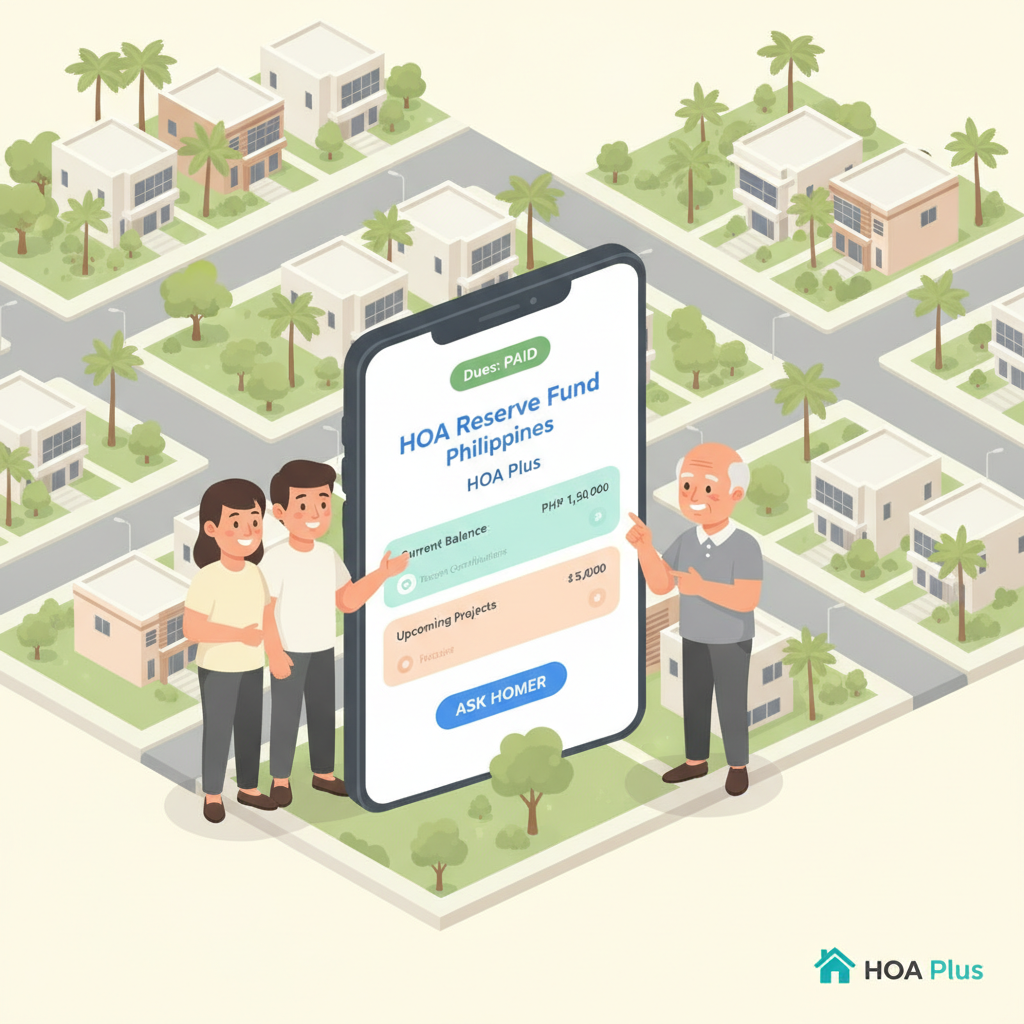
HOA Plus helps communities track both operating expenses and reserve fund balances in one transparent dashboard. Every homeowner can see exactly where their money goes. See how HOA Plus makes financial transparency easy for your community. For more on where your dues should go, read our guide on HOA Budgeting 101. For the fundamentals of how homeowners associations work, see What Is an HOA Philippines.
