
HOA Special Assessment Philippines | HOA Plus
HOA Special Assessments in the Philippines: What Every Homeowner Needs to Know
An HOA special assessment can catch any Filipino homeowner off guard. Your monthly dues feel fine. Then a notice arrives for an extra payment you never saw coming. If you have ever opened your mailbox to find a letter asking for thousands of pesos beyond your regular dues, you know that sinking feeling. What does it mean? Why now? And do you really have to pay it?
Take a deep breath. An HOA special assessment is not a scam. It is not a penalty. It is a tool your homeowners association uses to handle big, often urgent costs that the regular budget cannot cover. Once you understand how it works, you can plan for it instead of panicking about it.

What Is an HOA Special Assessment?
An HOA special assessment is a one-time fee your association charges on top of your regular monthly dues. Your standard dues pay for daily needs — security guards, garbage pickup, and street lights. A special assessment pays for something bigger. It might be urgent, like a typhoon-damaged gate. It might be a long-term upgrade, like repaving all the subdivision roads.
It is not forever. You pay it once and the obligation ends. For example, if a storm tears off the clubhouse roof, the board may ask every homeowner to help cover repairs. The regular reserve fund may not be enough. So the board spreads the cost across all residents. In the Philippines, special assessments fall under RA 9904, the Magna Carta for Homeowners and Homeowners Associations. This law sets the rules for how HOAs collect funds and what rights you have as a member.
Common Reasons for an HOA Special Assessment
Boards do not declare an HOA special assessment over small expenses. They use it for big, often unexpected costs that cannot wait for the next budget cycle. In Philippine subdivisions, three situations trigger most special assessments.
First, emergency repairs. A typhoon can tear down the perimeter fence. A flood can ruin the clubhouse floor. These repairs cannot wait six months for a budget review. Therefore, the board acts fast and asks everyone to chip in. Second, major infrastructure work. Roads that have not been repaved in twenty years need attention. The drainage system needs an upgrade. These are capital expenses far beyond what monthly dues save up in a year. Third, legal and compliance costs. If your subdivision faces a lawsuit or must meet new government rules, an HOA special assessment may bridge the funding gap.
The Difference Between Monthly Dues and an HOA Special Assessment
Many homeowners mix up special assessments with regular dues increases. They are not the same thing. Your monthly dues are steady and predictable. They cover day-to-day operations — the guard at the gate, the garbage truck, the street lights. These costs are budgeted for. The board approves them at the annual meeting. You know what to expect every month.
An HOA special assessment works differently. It is a one-time charge for a specific project. Once you pay it, you are done. The board cannot keep charging you for the same thing month after month. In addition, special assessments usually come with flexible payment terms. The board may let you pay over three, six, or even twelve months. They know that asking for ₱12,000 all at once is hard for most Filipino families.
How an HOA Special Assessment Is Calculated
The math behind an HOA special assessment depends on your association’s governing documents. Most Philippine HOAs use one of two methods. The equal method gives every homeowner the same peso amount. A townhouse owner and a large-lot owner pay the same. It is simple and easy to explain. The proportional method, however, bases each share on lot size or floor area. A bigger property pays more. This can feel fairer in communities where home sizes vary a lot.
Either way, the board must show you the numbers. They need to share the total project cost. They need to show how they arrived at your share. Furthermore, they should present contractor bids and a clear timeline. Transparency at this stage is not optional. A board that simply announces a number without backing it up invites suspicion. Trust between the board and residents starts with open books.
What to Do If You Struggle With an HOA Special Assessment
Getting hit with a special assessment when money is tight feels awful. Nevertheless, you have options. The first and most important step is to talk to your board. Do not stay silent. Do not ignore the notice. Many associations will work out a payment plan for homeowners facing real hardship — but only if you speak up early.
Therefore, go to the meeting where the board discusses the assessment. Ask questions. Request documents that show why the money is needed and how the amount was set. You have the right to see your association’s financial records. This includes the reserve fund balance, the contractor bids, and the board resolution. Under Philippine law, HOAs must keep clear financial records that every member can review.
If the full amount still feels impossible, ask about installments. A ₱12,000 assessment spread over twelve months becomes ₱1,000 per month. That is far easier to handle. Similarly, some HOAs let homeowners offer services in place of payment — for example, if you are a contractor, you might contribute labor instead of cash. Get any such agreement in writing. Meanwhile, remember that unpaid assessments can grow. Interest and late fees pile up. In serious cases, the association can take legal action. A conversation today is always better than a court case tomorrow.
How Technology Makes HOA Special Assessments More Transparent
Old-school HOA management makes it hard to track where special assessment money goes. Paper notices get lost. Handwritten receipts fade. A single volunteer treasurer holds all the records. When residents ask questions, the answers take days. This is where technology changes everything for both the board and the homeowners.
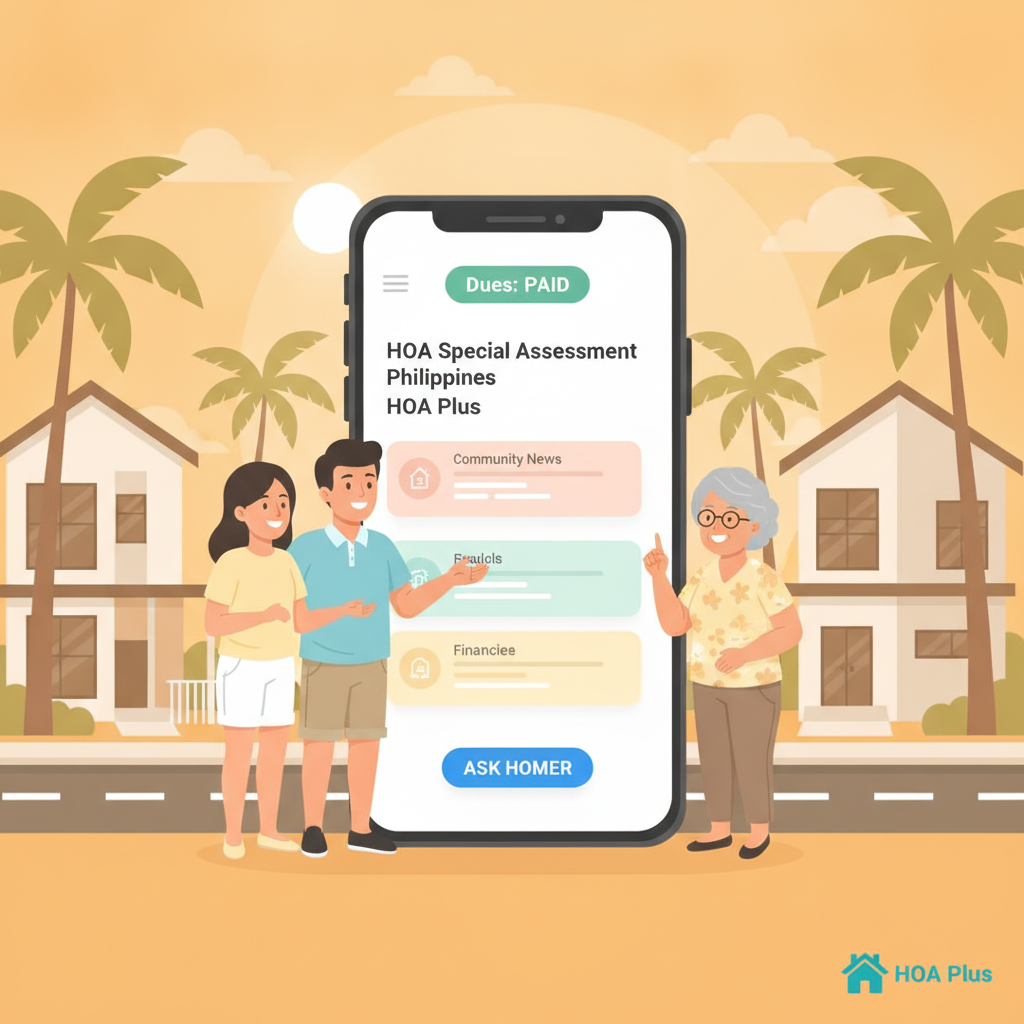
HOA Plus gives every resident a clear, real-time view of their account. You can see any active HOA special assessment, your payment schedule, and your remaining balance — all from your phone. No more calling the treasurer and waiting. You open the app. You see exactly what you owe and what you have paid. The board, meanwhile, can post project updates with photos. Residents watch their money at work, from the first bag of cement to the finished road.
For example, when the board levies a special assessment to repave the entrance, they create a project tracker inside HOA Plus. Every homeowner follows along. Contractor selected. Materials delivered. Work in progress. Job completed. This transparency kills the most common gripe about special assessments — the fear that money disappears into a black hole. Consequently, payment collection rates go up. Homeowners pay more willingly when they can see exactly where their pesos go.
If your board still handles special assessments through Facebook Messenger and spiral notebooks, share this with them. A digital platform does not just lighten their workload. It protects them from disputes and accusations. For more on smart HOA money management, read our guide on HOA Budgeting 101.
Your Rights as a Homeowner
You are not powerless when the board declares an HOA special assessment. Philippine law gives you specific protections against unfair or excessive charges. First, most special assessments need a vote at a general membership meeting. The board cannot simply impose one on their own — unless your bylaws give them that authority in writing.
Second, you can inspect every financial record tied to the assessment. Contractor quotes. Invoices. Receipts. The board resolution. If the board refuses to share these, that is a red flag. A real special assessment comes with paperwork. Third, the funds must serve a real community purpose. The board cannot charge a special assessment for personal projects or anything outside their authorized scope. The money must go toward common areas and shared facilities.
If you suspect something is wrong, raise it at a general meeting. For serious issues, you can seek mediation through your barangay or file a complaint with the Department of Human Settlements and Urban Development (DHSUD). Ultimately, an HOA special assessment is not meant to punish anyone. It is a shared investment in the place you call home. When the process is clear and the numbers are open, homeowners and boards can work together — without the resentment. For a closer look at how your dues are managed, see our article on HOA dues transparency in the Philippines.
Want your HOA to manage special assessments with complete transparency? Try HOA Plus free for your community and give every homeowner the clarity they deserve.